










































Healthy Kitchen/Healthy Stove

Local buy-in, knowledge, and communications capabilities were central to achieving the project mission. Organisers coupled product promotion with a multi-faceted communication campaign to raise awareness about the risks of indoor smoke and to introduce improved stoves and specific behaviours as effective tools for reducing exposure. The key strategy was to create local organisational capacity for raising awareness about the health risks of indoor smoke among the families of the 33 communities.
A series of presentations was developed to inform local leaders of the project's objectives and seek their collaboration. First, Centro ECO made presentations to provincial authorities and opinion leaders in the city of Ferreñafe, followed by two local meetings with community leaders in the villages of Uyurpampa and Incahuasi. To raise awareness about the project and its objectives among decision-makers throughout the country, brochures were produced and distributed by Centro ECO staff at meetings and seminars throughout the region and in the capital city of Lima.
The next task was establishing an organised cadre of promoters and other community leaders trained in the health risks of IAP, improved stove design and benefits, animal husbandry, and micro-loan management to ensure local capacity to carry on all aspects of the intervention beyond the life of the project. The idea was that building formal community structures facilitates initial community buy-in and ultimate ownership and responsibility for long-term results. To that end, Environmental Health Committees (EHCs) - composed of local leaders and trained promoters charged with educating the public about indoor smoke, improved stoves, and related behaviour and environmental health issues - were created in each participating community. Geographic clusters of committees in turn formed three Environmental Health Associations (EHAs) to oversee and administer an animal-based micro-loan system and to report progress and problems to Centro ECO.
A cadre of 33 promoters from the EHCs was trained to deliver messages directly to families using educational illustrations about the negative impacts of indoor smoke and the benefits and proper use and maintenance of improved stoves. In addition to this set of illustrations, Winrock worked with Centro ECO to develop a range of other communications materials to encourage behaviour change, raise awareness of the project, and elicit participation. These printed materials included: large banners and murals placed centrally in each village, smaller posters for broader distribution around the district, and flyers circulated through the village (containing information on the project, health impacts of smoke, stove construction, use and maintenance; and animal care). In addition, radio spots broadcast over a four-month period on a popular radio station reinforced these messages. Messages and graphic images were developed with help from local artists and feedback from focus groups. The materials used both Spanish and Quechua, as appropriate, and were culturally adapted for this high-Andean, Quechua population.
"Healthy Kitchen" competitions motivated participating families to take additional steps to create healthy and orderly kitchen environments. The goal was to provide additional incentives to natural leaders in the community to take pride in their kitchen environment and share their approaches with other women. A total of 22 competitions were held.
Health.
The district of Inkawasi is located in the high-Andean mountains of northwestern Peru, northeast of the city of Ferreñafe within the department of Lambayeque. It is an indigenous district with approximately 3,000 families in a mountain landscape that ranges from 1,800 to 3,200 meters above sea level. Quechua is the primary language, with Spanish the secondary language.
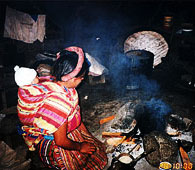
According to the Center for Sanitary Engineering and Environmental Sciences (CEPIS), the majority of indigenous populations in Latin America rely on biomass for cooking and heating. A significant portion of Peru's indigenous population is exposed daily to heavy levels of cooking smoke in confined kitchen spaces with little ventilation. The situation is particularly severe at higher elevations, where solid fuels are the only available options for cooking and cold temperatures and windy conditions lead people to cook almost exclusively indoors. Daily exposure to high levels of indoor smoke represents a serious health risk for the millions of indigenous economically poor who inhabit the high Andes, particularly women and children, who typically spend the most time near the fire during meal preparation.
According to the Ministry of Health, acute respiratory infection (ARI) was the leading cause of death in Peru in 2000, accounting for 9,753 cases or 12% of all reported deaths. Acute lower respiratory infection (ALRI) among infants and young children and chronic obstructive pulmonary disease (COPD) in adults are estimated to be significant contributors to mortality and morbidity among Peru's indigenous peoples of the high Andes. Peru's Country Environmental Analysis found that IAP contributes to: 25-40% of child ARI deaths in Peru, 20-30% of all ARI-related illness for children under five years of age, 15-25% of all ARI in adult females, and 20-40% of all cases of death and illness due to COPD.
Beginning in 2003, the energy team of United States Agency for International Development (USAID)'s Bureau for Economic Growth, Agriculture, and Trade, and the environmental health team of the Bureau for Global Health, jointly supported a cooperative agreement with Winrock International to develop models to reduce indoor air pollution by combining fuel-efficient cooking technologies with behaviour change messages and market-based distribution mechanisms. Winrock developed two project models: a peri-urban model piloted in Bangladesh, and the rural model in Peru described above.
Centro de Ecología y Género (Centro ECO) and Winrock International, with USAID funding.
The Development Experience Clearinghouse (DEC) Express, July 10 2009; and evaluation report [PDF], Winrock International, December 2008.
- Log in to post comments