










































Growing Women-Owned Businesses: WEConnect
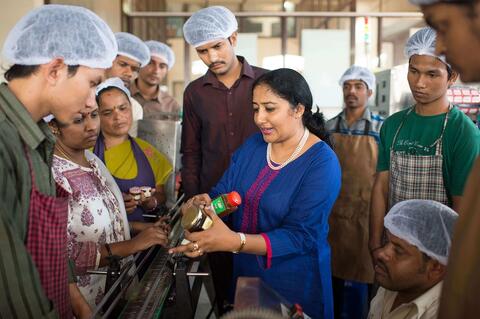
This research project is working to help women-owned businesses connect to global markets and enhance their growth prospects to support socioeconomic development and gender equality. WEConnect International, an international non-profit certification body for women's business enterprises, is connecting women-owned businesses to large private companies' supply chains. With support from Canada's International Development Research Centre (IDRC), the pilot project first focused on India, where researchers collected and maintain data on female-owned enterprises in India. WEConnect also conducted an analysis of a sample of businesses to understand the data gaps. This work is designed to strengthen WEConnect's eNetwork, which allows multinational firms that have committed to using their purchasing power to support women's economic empowerment to identify women-owned suppliers as potential vendors in their supply chains. The project also aims to provide tools for business and the wider community of practice. This pilot, which helped 600 women-owned businesses to be registered in the eNetwork and established almost 300 business connections, will also open similar venues for other Indian businesses to access these supply chains. The aim is to eventually roll out a data platform that serves and promotes women entrepreneurs from 17 other countries.
WEConnect International in India identifies, educates, registers, and certifies women's business enterprises that are at least 51% owned, managed, and controlled by one or more women. This process connects women-owned businesses with multi-national corporate purchasing organisations. In India, WEConnect began by establishing a high-level private sector advisory group to inform the project and enhance impact.
The information and communication technology (ICT)-based project involves strengthening the organisation's global brokering model with a searchable database, initially serving micro- to medium-sized businesses in India owned and managed by women. For example, Pushpa Parmar works for a women-led recycling cooperative, SEWA Gitanjali, which sells stationary items made from recycled paper to global brands such as Accenture, Staples, Goldman Sachs, and Cisco Systems. WEConnect's eNetwork facilitated these connections. Parmar's role involves training other people who are struggling how to earn a living by making stationary items. "My job has given me a chance to help others too, who were in the same situation as me, working on rubbish heaps," she says. "They were toiling all hours, in terrible conditions, and were earning just a pittance. Now they're employed in hygienic conditions and earning a proper wage."
Besides generating opportunities for women entrepreneurs, the project is producing data and knowledge about women's economic empowerment and women's business growth in India. Data points included: revenues for each company for each year as collected in assessments; number of employees; legal incorporation status; the most popular banks; access to lines of credit; and market focus. One finding: Just one-third of the women's business enterprises (WBEs) had access to loans or lines of credit through their banks. Organisers say that, given that the WBEs are growing and employing more people over time, global banks are missing a huge opportunity to invest in women.
WEConnect also provides direct support to small businesses operated by women through outreach events, training, networking, and mentoring. For example, Think Big: Women in Business Forum is a platform for women business owners. The third annual forum was held on October 9 2015 in Delhi, where 400 participants, including women entrepreneurs, corporate buyers, industry mentors, investors, and media, came together. Think Big 2014 brought delegates from 5 countries and 10 cities across India for experience sessions, business skill training workshops, business meetings, and peer learning.
Women, Economic Development
Across South Asia, women are far less likely to be employed than men, with less than a third of women holding or looking for a job, compared with 80% of men. According to the International Labour Organization (ILO), women's labour force participation rates in India declined in recent years, from about 37% in 2004-05 to 31% 7 years later. As in many developing countries, Indians who are employed are more likely to work in the informal sector, where income is low and benefits and protections are poor or nonexistent. Empowering more women to succeed as entrepreneurs is one way to address the persistent gender gap in employment and incomes.
International giant Walmart is among the global firms using WEConnect to increase the number of women-owned businesses in its supply chain. The company also promotes a "Women Owned" logo to help customers identify products made by women-owned firms certified by WEConnect. "Empowering women is the right thing to do for the community and it also makes good business sense," said Walmart's Jenny Grieser. "Walmart India's leadership in empowering women will be an example for other countries around the world."
WEConnect, IDRC
Emails from Liane Cerminara to The Communication Initiative on September 1 2016, September 9 2016, and September 12 2016 (including "IDRC and WEConnect International announce a new project to support the growth of women-owned businesses in Latin American and the Caribbean", "Connecting Women Entrepreneurs to Global Opportunities", Asia Research News, May 27 2016, "Empowering women-owned businesses in India", by Penny McRae, May 3 2016, WEConnect factsheet, and "Highlight: IDRC hosts WEConnect CEO for panel on empowering women entrepreneurs", by Louis Turcotte, March 24 2015); and International Development Research Centre (IDRC) website and WEConnect website - both accessed on September 12 2016. Image credit: IDRC
- Log in to post comments