










































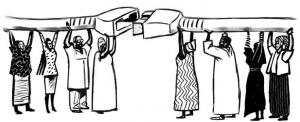
Fiber to Every Footpath: The Global Challenge of Equitable Access to the Information Highway
Open Research
Commissioned by the Association for Progressive Communications (APC) as part of a series on equitable access to information and communication technology (ICT) infrastructure, this 6-page summary article captures the issues raised by presentations and discussions at an event held by APC in Rio de Janeiro, Brazil, in November 2007. According to the author, "... about 97% of the African population and 90% of the Asian population did not own fixed-line phones or computers and were not users of the internet in 2005. In today’s world of high technology and change, how do we ensure that the majority of the planet’s population - especially the poor and marginalised - don’t get left out? Or, to put it differently: What can make access to ICTs real for people?"
The document differentiates between "equal" access and "equitable access: "What can be used by local communities to improve their own lives may differ from one village to the next, or between cities, countries and regions....Equitable access is not just about building networks, but also about creating a good policy framework, choosing appropriate and sustainable technologies, and developing both for-profit and nonprofit business models that work. The papers presented focused on ICT policy issues; people, networks and capabilities; business models for sustainable access; and tools and technologies, such as wireless and free and open source software (FOSS)."
The document frames ICT access as being about human rights because a lack of it can translate into economic and social inequality. It indicates that "the market alone will not guarantee equitable access. As a result, policies are needed to 'bridge the access gap at the bottom of the pyramid,' and attend to underlying challenges such as economic, rural/urban, skills and gender 'divides'. The challenge is multi-sectoral, and needs to involve the participation of affected communities." Case studies demonstrated community-centred access project planning, for example, the Indian government’s plan to roll out 100,000 telecentres, and emphasised the importance of a sense of grassroots ownership when connecting rural villages. Another example from Brazil showed that a community could offer in-kind support for a network being constructed in its area, including security, the use of empty buildings, or cheap labour, and could also be actively involved in decisionmaking processes. This project successfully constructed over 100 telecentres in Sao Paulo, Brazil.
However, there are challenges due, in part, to the rapid global ICT landscape changes, in which technologies and markets are in flux. In addition, specific contexts are diverse, and may require tailor-made policy applications; and policymakers may be self-interested. The document suggests that "[n]ew policy perspectives include piggy-backing ICTs on other infrastructure projects, such as the building of roads or hospitals, and insisting on 'open access' regimes where national and regional infrastructure such as fibre optic cable can be sold at cost to all stakeholders."
The conference looked at equitable access and asked, "Who will pay for it?" A public/private form of business model may allow for both the private sector and the community to benefit: "by empowering the community, vendors and service providers could tap untapped local markets, or even lay the ground for fresh ones." Presenters debated the effect of lowering the end user cost. They discussed the need for more transparency in the collection and spending of universal access funds (funds collected by governments through levy from private providers to bridge the access divide). A voucher system was suggested for the economically poor, whereby vouchers would be used to pay for telecentre access; telecentres would collect them and submit them to the government for payment.
Participants discussed a range of issues that affect the take-up of technology on the ground, including affordability, energy efficiency, and open standards, which increase the potential for interoperability of software and hardware, and allow the community to use, change, and share technology more easily. Increasing the spectrum of bandwidth also increases the uptake of ICT. For example, a Tanzania project started with an expensive dial-up connection, which was replaced with VSAT satellite in 2004. "This brought new innovations to the local community, including building point-to-point long-distance wireless connections that linked small businesses and institutions, and the sharing of costs. Telecentre operators learned about setting up networks and trouble-shooting viruses, amongst other technical problems. From the start, ...the project was mostly independent of 'Northern experts': 'The knowledge stays within the organisation, which is a great source for sustainability.'"
In order to serve the community needs, the recommendation is for"... a 'citizen framework', where the community is involved in the development and management of ICT services, rather than a 'consumer framework'...Women and other marginalised groups, such as the disabled and language minorities..." should be part of the focus, which should include global alliances.
APC website on December 22 2008; and emails from Alan Finlay and Lisa Cyr to The Communication Initiative on January 29 2009 and February 2 2009, respectively.
- Log in to post comments