










































Feasibility and Acceptability of a Video Library Tool to Support Community Health Worker Counseling in Rural Afghan Districts: A Cross-Sectional Assessment
FHI 360 (Dal Santo, Pradhan, Tharaldson, Dulli, Todd); Boston College School of Social Work (Dal Santo); FHI 360/ HEMAYAT project (Rastagar, Alami); Ministry of Public Health, Islamic Republic of Afghanistan (Hemat)
"[V]isual media within mHealth are under-utilized for engaging clients, their families, and communities in RMNCH promotion..."
Rural Afghan populations have low skilled birth attendance rates and high maternal and infant mortality. Insecurity and armed conflict, geographic barriers, and cultural norms often hinder women's access to facility-based reproductive, maternal, newborn, and child health (RMNCH) services, including immunisation. Community health workers (CHWs) are critical agents for behavioural change in fragile settings such as this one, where RMNCH information exposure is limited by low literacy and mass media access. This study assessed the feasibility and acceptability of a computer-tablet-based health video library (HVL) to enhance CHW counseling on RMNCH topics in three rural Afghan districts.
In general, in Afghanistan, volunteer CHWs, comprising one male and one female CHW for each health post (catchment area of up to 150 households), participate in 9 weeks of didactic training and 8 weeks of practical training that includes counseling techniques, sensitisation, and social norms accommodation to facilitate community engagement on sensitive topics, like family planning (FP). Due to gender norms in Afghanistan, female CHWs generally interact solely with female clients within households and health posts, while male CHWs convene education and mobilisation sessions for male clients at community events and coordinate referrals.
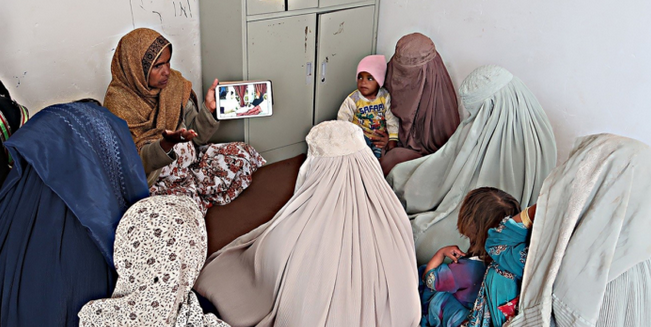
The HVL programme uses short educational videos portraying specific health topics to support CHW counseling, with the aim of improving RMNCH knowledge and practices among community members. The HVL design was informed by a formative study among youth of both sexes and adult men that found that visual communication channels were preferable to most groups, particularly female youth. Produced in Kabul in Dari and Pashto languages, the videos were developed by the United States Agency for International Development (USAID)-funded Helping Mothers and Children Thrive (HEMAYAT) project in collaboration with the Ministry of Public Health (MoPH). Along with preexisting MoPH-approved content on nutrition and immunisation topics, the videos loaded onto tablets. The teams also developed accompanying counseling materials containing key messages and action points for CHWs to convey after showing the videos. The newly created videos, training manual, and post-video counseling guidelines were pre-tested in provinces with ethnic and linguistic diversity prior to pilot-testing in three rural Afghan districts beginning in July 2017. This manuscript presents findings from an assessment of the pilot-testing in order to improve activity design and content prior to scale-up.
Specifically, the HVL was introduced by trained CHWs in 30 villages in Char Kent District (Balkh Province), Karukh District (Herat Province), and Daman District (Kandahar Province). In Herat, only female CHWs implemented the intervention, while both male and female CHWs were trained to implement the intervention in Kandahar and Balkh. The rationale for this decision was to explore whether male CHWs perceived value in and actually used the VL and whether gender-based issues affected tablet sharing and VL exposure when male CHWs were involved. In two provinces (Kandahar and Balkh), male CHWs were involved with an adaptive programme design to engage men to view the HVL at health posts at activity inception; based on popular demand in Herat, this feature was added in October 2017.
The researchers used a mixed-methods study design to assess exposure to and perception of the HVL 6 months post-introduction. They surveyed married women (n=473) and men (n=468) with at least one child under 5 years and conducted in-depth interviews with CHWs and community leaders (shuras and family health action groups) within pilot communities (n=80).
The assessment found that higher proportions of women in Balkh (60.3%) and Herat (67.3%) reported viewing at least one HVL video compared to women in Kandahar (15%), while male HVL exposure was low (8-17%) across all districts. The CHWs reported that the novelty of the approach and technology was initially concerning to community members, since women were not used to videos. Relatedly, four surveyed women in Kandahar remarked on the offensive behaviour they had seen by women in a video (on vaccination) they had watched. The complaint arose from perceptions that actors were immodestly dressed and covered. Moreover, in some HVL implementation areas, it is not culturally acceptable for women to be photographed or filmed.
Breastfeeding, child vaccination, care during pregnancy, newborn care, and FP were among the video topics female survey respondents reported liking most. When probed about the types of videos that were most appealing to beneficiaries, a few CHWs said clients especially enjoyed videos with humorous scripts or songs (e.g., the vaccine video). In addition, one CHW remarked that women liked topics that related directly to them.
There were some specific HVL topics described as difficult for clients to understand. For example, CHWs in Herat considered the immunisation video the most difficult to use, which required them to play the video multiple times. In contrast, CHWs in Balkh and Kandahar found the immunisation video easy to discuss in counseling. On that note, most HVL-exposed clients (85-93% of women and 74-92% of men) reported post-video counseling by CHWs. Nearly all female (95.1-100%) and most male (81.1-92.9%) survey respondents across all provinces cited finding the post-video discussions useful.
Nearly all (94-96% of women and 85-92% of men) were very interested in watching videos on other health topics in the future. Although considerably fewer men than women were reached by the HVL, some men in Herat reportedly transferred videos to their mobile phones so they could watch and share them with peers. As perceived by one community leader, men's interest in the HVL was driven by the desire to learn how to avoid illness-related expenses.
The HVL reportedly increased acceptance of CHWs' role in the community. A female CHW from Herat said: "Women were thankful to watch these videos. Previously, women did not trust in us [CHWs] that much but after watching videos, they trust more in us because they have watched and liked all topics." All community leaders requested that the HVL be sustained and extended to other communities.
Clients provided recommendations to improve the HVL. Suggestions mainly centred on creating new video content and expanding HVL to other communities. Examples of other recommendations included ensuring that HVL message content is clear and simple, making all videos available in the language of the viewing district, and providing all CHWs in the community with tablets.
In reflecting on the findings, the researchers explain that Kandahar's lower CHW and HVL exposure is attributable to significant cultural limitations to women's movement outside the household; male family members (mahram) must accompany the woman to all places. These cultural constraints also apply to female CHWs, whose ability to conduct health post and home visit sessions was limited compared to their Balkh and Herat counterparts. In this study, female CHWs reported infrequent or forfeited tablet possession, as tablets were ceded to male CHWs due to gender norms regarding property ownership and perceived need. Social norms resulting in male CHW tablet possession may explain why men in Kandahar were more likely to have viewed HVL videos than women. With respect to low HVL exposure among men, pilot implementation did not include specific male engagement events, likely contributing to low male exposure across districts.
Per the researchers: "Relatively low reported HVL exposure among women in Kandahar and among men in all provinces indicates a need for activity design modification. Specifically, broad community notification and endorsement by community leaders at HVL introduction and ongoing engagement with these stakeholders is critical to ensuring that community members, particularly women, are able to access health posts for HVL exposure and subsequent care and referral needs."
To establish a more conducive environment for HVL uptake in scale-up, the researchers added an introductory HVL session with key influencers that men trust (e.g., community shura and community mullah/imam) prior to community introduction. During these "soft openings", trained CHWs introduce the programme, show leaders the videos and have them experience the counseling, and provide a brief overview of the pilot assessment's findings. Other steps to engage men in HVL during scale-up will include the provision of a separate tablet to male CHWs and the scheduling of special male audience times, such as after Friday prayers.
Another example of the project's action for scale-up in response to assessment findings is the addition of a line of videos called Opinion Leader videos, where CHWs identify community members who have successfully adopted a new behaviour and navigated barriers to doing so. In the videos, these community members describe how they were able to adopt the new behaviour and, by doing so, incite conversation around and solutions to transform harmful social norms.
By using such tactics, scale-up of the HVL will aim to "better engage men and other key influencers to engineer local solutions that directly facilitate male HVL exposure, indirectly improve women's HVL access, and support collaborative spousal health decision-making. A larger efficacy trial is warranted to measure the HVL's effect on knowledge and health-related behavioral outcomes."
In conclusion: "Digital tools such as the HVL are not a panacea for increasing RMNCH knowledge and service utilization in this and other under-resourced settings; however, provided sustained engagement with CHWs, community leaders, and other key stakeholders (e.g. MoPH), these tools offer a promising, additional channel through which to communicate important RMNCH messages."
Conflict and Health (2020) 14:56. https://doi.org/10.1186/s13031-020-00302-z. Image credit: Lailoma Barekzai/HEMAYAT Jhpiego
- Log in to post comments