










































Evaluating a Community Engagement Model for Malaria Elimination in Haiti: Lessons from the Community Health Council Project (2019-2021)
Affiliation
University of Washington (Bardosh); The Carter Center (Bardosh, Desir, Jean, Yoss, Poovey, Nute, de Rochars, Noland); Ministère de la Sante Publique et de la Population, Jeremie and Port‑au‑Prince, Haiti (Telfort, Benoit, Chery, Charlotin); University of Florida (de Rochars)
Date
Summary
"The CHCs [community health councils] helped build local capacity for malaria activities in settings where formal health staff and outreach is low and minimal, and increased the number of routine malaria interventions at the sub-commune level, especially education at schools, churches and community venues and environmental sanitation activities."
Broadly speaking, community engagement (CE) is the process of engaging those who are affected by a particular problem in the process of solving and mitigating that problem. Despite the increased emphasis on CE in malaria programmes, CE approaches vary substantially, with more participatory programmes requiring higher levels of adaptive management. This study evaluates the effectiveness of a volunteer-based CE programme developed implemented in Haiti as part of Malaria Zero Consortium activities. It draws on quantitative and qualitative data collected from 23 community health councils (CHCs) over a 2-year period in Grand'Anse department, a malaria hotspot region in Haiti. (Hispaniola (Haiti and the Dominican Republic) is the last remaining malaria-endemic island in the Caribbean.)
The approach was based on local leaders organising and implementing monthly anti-malaria activities in their communities. The CHC model was informed by a 4-week formative research period organised in mid-2018 in two communes of the department (Moron and Roseaux). A team of 10 field researchers conducted 254 individual interviews and 252 group discussions on local understandings of fever, malaria treatment-seeking behaviour, community trust and confidence in social institutions and networks, sources and channels of health communication, community perceptions of the malaria programme, and community views on the possibility of malaria elimination. This process led to the finalisation of a conceptual working document, Malaria Zero Community Engagement Plan, in mid-2018, the organisation of a training workshop for each CHC in 2018, training workshops on community mobilisation and malaria in 2019, and the 2020 finalisation of a CHC implementation manual and a monitoring, evaluation, and learning handbook.
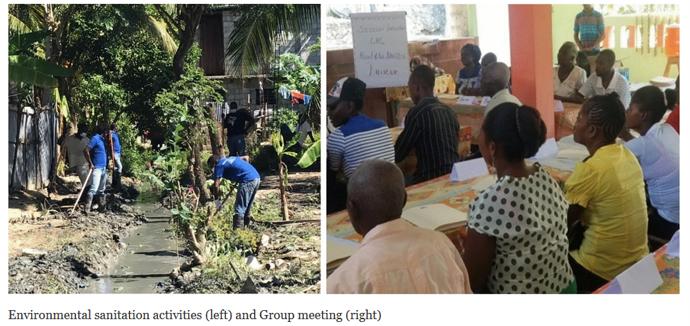
Five communes (out of 12) were selected for an initial pilot phase that began in 2018. A total of 23 CHC groups were established at the sub-commune level through an open and transparent process that aimed to ensure a broad representation of professional backgrounds, gender, age, socioeconomic status, and residence location in the CHCs. The original goal of the CHC programme was to have each group organise one planning meeting and four community-based activities per month. Clean-up equipment (including wheelbarrows, shovels, boots) were provided to each CHC to facilitate and encourage environmental sanitation activities.
This paper is based on 24-months of data collected from June 2019 to May 2021, including monthly monitoring data, two rounds of qualitative interviewing and observational notes gathered during training and monitoring visits. Data showed that 100% of the 23 CHCs remained functional over the 2-year period, with an average of 0.90 monthly meetings held with an 85% attendance rate. A high degree of transparency and diversity in membership helped create strong planning and involvement from members. CHCs conducted an average of 1.6 community-based activities per month, directly engaging an average of 123 people per month. High levels of fluctuation in monthly activities were indicative of local ownership and self-organisation. Activities included school and church sensitisation, environmental sanitation campaigns, mass education, support for case referrals, and community mobilisation during mass drug administration (MDA) and indoor residual spraying (IRS) campaigns. Interviews and observations showed that the campaigns likely over-emphasised general clean-up instead of mosquito control. Larger campaigns were often organised to correspond to festivals or holidays. Megaphones provided to CHC were used for sensitisation at water kiosks, bus stops, public squares, markets, and street corners as well as and during door-to-door education.
CHCs adapted the implementation guidelines in ways that made sense to them and aligned with shared group priorities. Most CHCs created their own oaths, mission statements, and songs, and many also formed WhatsApp or Short Message Service (SMS) chat groups. These efforts emerged spontaneously. Group decision-making was described in terms of consensus generation, and CHC members pointed to the fostering of a shared sense of purpose that relied on existing social networks.
Qualitative data found that CHC members strongly linked the transparent membership selection process, which ensured a diversity of community representation, to the effectiveness of CHC activities and their sustained functioning. Group members contrasted this experience to the more top-down and opaque selection process used in many other development and health projects in Haiti. Members drew on the tradition of konbit (mutual self-help), a culture of volunteerism that has long been a feature of the Haitian Catholic church, and "solidarity" in difficult times as they negotiated their agency as community volunteers. Small incentives played both symbolic and supportive roles.
Common challenges involved the distance some members had to travel to attend meetings, the reimbursement of small expenses used by individual members, and a lack of protocols and guidance in planning. CHCs emphasised their ability to "change behaviours", though members requested more training on behaviour change techniques; many found it very challenging and time-consuming. Interviews in 2019 and 2020 also found that many members did not feel sufficiently trained on malaria. CHC members described the need for the "separation of power" and emphasised the power dynamic of group membership. Rumours about financial and political profiteering of CHC volunteers took time to dispel, while the tendency towards vertical planning in malaria control created conditions that excluded CHCs from some activities.
Thus, the data show that the CHC approach could be implemented and maintained in Haiti, despite programmatic and contextual challenges. The model was effective in promoting group solidarity and community-based anti-malaria activities. With the end of the Malaria Zero Consortium in early 2021, there is now an opportunity to better integrate this programme into the primary healthcare system, to evaluate the impact of the CHCs on malaria epidemiology, and to promote the greater integration of CHCs with active surveillance and response activities.
Broadly speaking, community engagement (CE) is the process of engaging those who are affected by a particular problem in the process of solving and mitigating that problem. Despite the increased emphasis on CE in malaria programmes, CE approaches vary substantially, with more participatory programmes requiring higher levels of adaptive management. This study evaluates the effectiveness of a volunteer-based CE programme developed implemented in Haiti as part of Malaria Zero Consortium activities. It draws on quantitative and qualitative data collected from 23 community health councils (CHCs) over a 2-year period in Grand'Anse department, a malaria hotspot region in Haiti. (Hispaniola (Haiti and the Dominican Republic) is the last remaining malaria-endemic island in the Caribbean.)
The approach was based on local leaders organising and implementing monthly anti-malaria activities in their communities. The CHC model was informed by a 4-week formative research period organised in mid-2018 in two communes of the department (Moron and Roseaux). A team of 10 field researchers conducted 254 individual interviews and 252 group discussions on local understandings of fever, malaria treatment-seeking behaviour, community trust and confidence in social institutions and networks, sources and channels of health communication, community perceptions of the malaria programme, and community views on the possibility of malaria elimination. This process led to the finalisation of a conceptual working document, Malaria Zero Community Engagement Plan, in mid-2018, the organisation of a training workshop for each CHC in 2018, training workshops on community mobilisation and malaria in 2019, and the 2020 finalisation of a CHC implementation manual and a monitoring, evaluation, and learning handbook.
Five communes (out of 12) were selected for an initial pilot phase that began in 2018. A total of 23 CHC groups were established at the sub-commune level through an open and transparent process that aimed to ensure a broad representation of professional backgrounds, gender, age, socioeconomic status, and residence location in the CHCs. The original goal of the CHC programme was to have each group organise one planning meeting and four community-based activities per month. Clean-up equipment (including wheelbarrows, shovels, boots) were provided to each CHC to facilitate and encourage environmental sanitation activities.
This paper is based on 24-months of data collected from June 2019 to May 2021, including monthly monitoring data, two rounds of qualitative interviewing and observational notes gathered during training and monitoring visits. Data showed that 100% of the 23 CHCs remained functional over the 2-year period, with an average of 0.90 monthly meetings held with an 85% attendance rate. A high degree of transparency and diversity in membership helped create strong planning and involvement from members. CHCs conducted an average of 1.6 community-based activities per month, directly engaging an average of 123 people per month. High levels of fluctuation in monthly activities were indicative of local ownership and self-organisation. Activities included school and church sensitisation, environmental sanitation campaigns, mass education, support for case referrals, and community mobilisation during mass drug administration (MDA) and indoor residual spraying (IRS) campaigns. Interviews and observations showed that the campaigns likely over-emphasised general clean-up instead of mosquito control. Larger campaigns were often organised to correspond to festivals or holidays. Megaphones provided to CHC were used for sensitisation at water kiosks, bus stops, public squares, markets, and street corners as well as and during door-to-door education.
CHCs adapted the implementation guidelines in ways that made sense to them and aligned with shared group priorities. Most CHCs created their own oaths, mission statements, and songs, and many also formed WhatsApp or Short Message Service (SMS) chat groups. These efforts emerged spontaneously. Group decision-making was described in terms of consensus generation, and CHC members pointed to the fostering of a shared sense of purpose that relied on existing social networks.
Qualitative data found that CHC members strongly linked the transparent membership selection process, which ensured a diversity of community representation, to the effectiveness of CHC activities and their sustained functioning. Group members contrasted this experience to the more top-down and opaque selection process used in many other development and health projects in Haiti. Members drew on the tradition of konbit (mutual self-help), a culture of volunteerism that has long been a feature of the Haitian Catholic church, and "solidarity" in difficult times as they negotiated their agency as community volunteers. Small incentives played both symbolic and supportive roles.
Common challenges involved the distance some members had to travel to attend meetings, the reimbursement of small expenses used by individual members, and a lack of protocols and guidance in planning. CHCs emphasised their ability to "change behaviours", though members requested more training on behaviour change techniques; many found it very challenging and time-consuming. Interviews in 2019 and 2020 also found that many members did not feel sufficiently trained on malaria. CHC members described the need for the "separation of power" and emphasised the power dynamic of group membership. Rumours about financial and political profiteering of CHC volunteers took time to dispel, while the tendency towards vertical planning in malaria control created conditions that excluded CHCs from some activities.
Thus, the data show that the CHC approach could be implemented and maintained in Haiti, despite programmatic and contextual challenges. The model was effective in promoting group solidarity and community-based anti-malaria activities. With the end of the Malaria Zero Consortium in early 2021, there is now an opportunity to better integrate this programme into the primary healthcare system, to evaluate the impact of the CHCs on malaria epidemiology, and to promote the greater integration of CHCs with active surveillance and response activities.
Source
Malaria Journal (2023) 22:47. https://doi.org/10.1186/s12936-023-04471-z.
- Log in to post comments