










































Effectiveness of a Web-Based Tailored Intervention With Virtual Assistants Promoting the Acceptability of HPV Vaccination Among Mothers of Invited Girls: Randomized Controlled Trial
Netherlands Organization for Applied Scientific Research, or TNO (Pot, Paulussen, Eekhout, van Keulen); Maastricht University (Pot, Ruiter); VU University Medical Center (Eekhout); National Institute for Public Health and the Environment (de Melker); Leiden University (Spoelstra)
The aim of this study was to evaluate the effectiveness of a Web-based tailored intervention, featuring virtual assistants, for promoting human papillomavirus (HPV) vaccination acceptance in the Netherlands by means of a randomised controlled trial (RCT). Specifically, the RCT assessed the effectiveness of the intervention on HPV vaccination uptake among the participants' daughters (primary outcome). Secondary outcomes were the mothers' degree of informed decision making (IDM - when a person has sufficient and relevant knowledge and when her values (attitude) and behaviour match), decisional conflict, and the social cognitive determinants of decision making about the daughters' HPV vaccination uptake (e.g., attitude, intention, and beliefs).
The introduction to the paper provides context for the intervention. In 2008, the Health Council advised the Ministry to include the HPV vaccination for girls aged 12 years in the National Immunization Program (NIP). Initial implementation started with a catch-up campaign in 2009 for girls aged 13 to 16 years. Since 2010, new cohorts of 12-year-old girls have been invited by the NIP to receive the HPV vaccination on a yearly basis. The municipal health services organise local sessions for group-based HPV vaccination, usually at large venues. This restricts the opportunity for interaction between the parent and girl with the professional. Perhaps in part for this reason, HPV vaccination uptake in the Netherlands has remained lower than expected: 61% uptake in 2016. Prior to the creation of the intervention being evaluated in this RCT, the regular invitation for the HPV vaccination comprised an introduction folder and a link to a website providing universal information about HPV and HPV vaccination. However, research indicated that mothers feel the need for interactive personal information about the HPV vaccination. (Research has indicated that Dutch mothers play the most important role in decision making about girls' immunisation.)
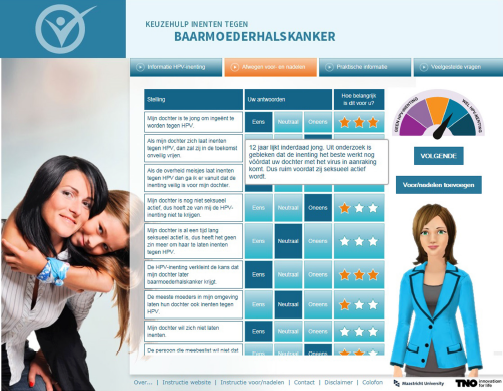
The process of development of the intervention is described in detail in a related paper, available at the link below. But, in brief, the researchers created an interactive website providing mothers of girls to be invited for the HPV vaccination in 2015 (i.e., girls born in 2002) with tailored feedback from 2 virtual assistants: a mother- and doctor-like assistant. The basic method for change was computer tailoring, which is a health communication strategy in which messages are individualised to the person's preferences and needs. Examples of change techniques that were used in addition to tailoring were consciousness raising (targeting risk perception), belief selection (targeting beliefs), active learning (targeting knowledge retention), and motivational interviewing (targeting decisional conflict and attitude change). The website consisted of 4 menu options: 2-sided information about the HPV vaccination, a decisional balance, practical background information, and frequently asked questions (FAQs). Before completing the concept intervention, the researchers experimentally pretested 3 different intervention components and conducted 3 focus groups for pretesting the prototype's feasibility.
Conducted between January 2015 and March 2015, the RCT assessed intervention effects on HPV vaccination uptake using Praeventis, which an electronic national immunisation register in the Netherlands. Because invited girls were given the opportunity to catch up on their missed HPV vaccinations, complete data on uptake were only available 18 months after baseline (i.e., July 2016). The effects on secondary outcomes were examined by 2 Web-based surveys: at baseline and at follow-up, just before they received the first HPV vaccination (time intervals around 2 months). Participants in both arms had access to the universal information about the HPV vaccination as part of the regular invitation for the HPV vaccination.
The final sample consisted of 8,062 mothers: 3,995 mothers in the intervention condition and 4,067 in the control condition. On average, mothers had a positive intention toward the HPV vaccination of their daughter at baseline (mean 5.35 [standard deviation (SD) 1.69]).
Intention-to-treat analysis (ITT) showed that the intervention had a significant positive effect on all secondary outcomes (P<.001), except for risk perception when not vaccinated, anticipated regret, and self-efficacy (P=.01; P=.01; P=.03, respectively). Compared with the control group, at follow-up, mothers in the intervention group were more informed (dichotomous measure: odds ratio (OR)=1.28, P<.001; continuous measure: beta=1.72, P<.003), experienced less decisional conflict (beta=.21, P<.003), were more intended to vaccinate their daughter (beta=.18, P<.004), had a more positive attitude toward vaccinating their daughter (beta=0.15, P<.004), had more positive beliefs (e.g., beliefs about the safety and effectiveness of the HPV vaccination; beta=.12, P<.003), had a lower risk perception when they imagined that their daughter was vaccinated (beta=-.11, P<.003), perceived more positive subjective norms (beta=.82, P<.003), reported a higher relative effectiveness (beta=.46, P<.003), and had more knowledge (beta=.35, P<.003). Effect sizes were small.
The ITT also showed that there was no effect of the intervention on HPV vaccination uptake (OR=1.03, P=.60). The researchers point to the fact that, in the study, the uptake rates were high in both conditions (intervention: n=3,995; 73.17% and control: n=4,067; 72.71%), especially when compared with the national Dutch uptake (n=59,866; 60.98%). Furthermore, they did find a larger increase in intention among mothers in the intervention compared with the control condition, and according to theory and empirical findings, intention is an important predictor of (HPV vaccination) behaviour.
Mothers evaluated the intervention as positive, specified by the high subjective evaluation of both the website (7.6 on a 10-point scale) and the virtual assistants (7.4 on a 10-point scale). Objective programme use was also high, with 62.80% (n=2,509) of the invited mothers having visited the website. In addition, on average, they spent quite some time on the website (22 minutes).
Taken together, the researchers suggest, the findings indicate that this intervention has potential for broad national dissemination and implementation. They recommend developing (tailored) interventions that are designed to reach the daughter and the mother's partner, as these appear to be important social referents. In addition, boys may also become a relevant group to reach. In other countries, boys are already included in the national immunisation programme. This may contribute to the achievement of herd immunity and to a reduction of the global burden of a variety of HPV-related cancers in women and men.
Journal of Medical Internet Research. 19(9): e312. doi: 10.2196/jmir.7449.
- Log in to post comments