










































Early Effects of Family Conversation on Institutional Deliveries, Early Postnatal and Newborn Care Practices in Rural Ethiopia: A Propensity Score-Matched Analysis
John Snow Institiute
Background to the presentation as taken from the abstract:
“At 29 neonatal deaths per 1,000 live births, the neonatal mortality rate (NMR) in Ethiopia is amongst the highest in sub-Saharan Africa. The maternal mortality ratio (MMR) of the country is currently 497 per 100,000 live births which is 86 percent higher than the target for the indicator to be reached by 2015. Since the majority of the neonatal and maternal deaths take place at childbirth or within two days following that, ensuring childbirths at institutions with emergency obstetric and newborn care services and postnatal follow-up of mother and newborn with 48 hours of deliver are among the mainstream strategies to reduce MMR and NMR. The Last Ten Kilometers Project (L10K) supports Ethiopia’s health extension program (HEP) to improve reproductive, maternal, newborn and child health outcomes in 115 rural districts of the country (in Amhara, Oromia, SNNP and Tigray regions) covering a population of about 17 million. In early 2014, L10K introduced ‘family conversation’ to promote institutional deliveries (ID), early postnatal care (PNC) and immediate newborn care (INC) practices.” This presentation which forms part of the session on “Intimate Talk - Couples and Family Health”, looks at the early effects of family conversation on institutional deliveries, early postnatal and newborn care practices as measured through a propensity score-matched analysis.
Following a brief introduction to the paper, the presentation explains the Ethiopian health case systems, including the primary health care system and how it works at different levels using health development teams.
Betemariam then goes on to explain the objectives of the L10K project and outlines the following overall project activities which target 17 million people in 115 woredas (districts):
- Training to enhance the skills of Health Extension Workers (HEWs) to provide community-based maternal, newborn, and child health (MNCH) services;
- Collection of community-based data for decision making for targeted services;
- Anchoring the Health Development Army (HDA) in local institutions to sustain volunteerism;
- Facilitation of family conversations;
- Birth notification;
- Strengthening linkages within Primary Health Care Units (PHCU);
- Regular supportive supervision for HEWs; and
- Woreda-level review meetings.
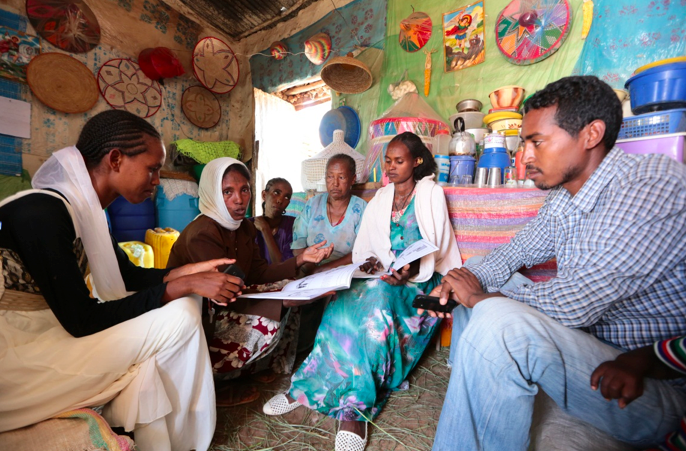
She explains that the conversations are organised by trained HEWs and in some cases HDAs may also facilitate conversions. These conversations take place in the pregnant woman’s home and also include the husband, mother in-law, and neighbours to engage them and ensure their support during pregnancy, labour, and postpartum periods. The intervention consists of two sessions of family conversations which follow three steps of discussion - exploration, discussion, and joint planning. The sessions are supported by family conversation guides.
The presentation then goes on to explore the evaluation methods which used cross sectional survey data to compare programmatic outcomes between those who reported having had family conversations during their last pregnancy and those who did not. Betemariam explains how the data was analysed using propensity score match (PSM) analysis to estimate average treatment effect. This is followed by an outline of the results of the analysis with the help of graphs and tables, which showed the impact of conversation on institutional delivery, PNC in 48 hours, clean cord care, thermal care, initiating breastfeeding immediately after birth, and exclusive breast-feeding, comparing results with those who had family conversations and those that did not. As explained in the presentation, overall, about 16 percent of the respondents reported having had family conversation during their last pregnancy. The results showed that family conversation significantly improved coverage of institutional delivery, post natal care with in 48 hours, thermal care, and exclusive breastfeeding.
The presentation ends off by outlining some lessons learned and recommendations:
- Household members who are also caregivers and major decision-makers, especially husbands and mother-in-laws, should be part of the target audience for behavioral change communication (BCC) to improve maternal and newborn care seeking behaviour and practices;
- Although the family conversation was effective, its coverage was low;
- HEP should seek strategies to improve the efficiency of reaching the target audience with similar BCC messages.
- Log in to post comments