










































e-Democracia
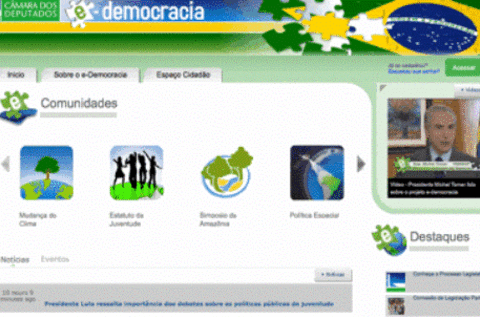
e-Democracia Project in Brazil, a website launched in June 2009 by the Brazilian House of Representatives, is designed to engage citizens in the lawmaking process to achieve tangible legislative results. The main goal is to permit easier access to the decision-making process by citizens who are not associated with strong interest groups or corporations that usually lobby for access to the centre of power in Brasilia where the national government is located.
Relying on the use of social media combined with offline legislative events (e.g., committee hearings, conferences), the initiative is intended to reach a broad segment of the public, including citizens, parliamentarians, civil servants, researchers, non-governmental organisations, and interest groups.
The programme is designed for crowd-sourcing (aggregating information from diverse sources, often by topic or location) for legislative purposes. "In particular, the e-Democracia website is designed to attract and draw together the diffuse participation of individual citizens and minority groups."
Since the launching of e-Democracia in 2009, its team has invested in several strategies to promote the website and engage a broader group of participants. First, articles about the e-Democracia initiative were published in the national e-newspapers. Its website is accessible and open to anyone who completes a registration process. There is also a link to it at the Brazilian House’s website. Second, the e-Democracia team sent out invitations to thematic blogs and social networking websites to engage people (e.g., environmentalists and youth) who are interested in specific issues. Third, the e-Democracia team posts daily messages in the e-Democracia’s accounts at Twitter and Orkut (a social networking site reported to be more popular than Facebook in Brazil).
The project was begun by young legislative officials and organisational activists for the purpose of increasing involvement and transparency in the legislative process. The group persuaded legislators to allow an experimental version for which 3-5 bills were suggested based upon the criteria:
"1. the potential engagement of representatives in the digital discussions; and
2. the issues that were "hot", i.e., subjects that a significant segment of Brazilian society urgently wanted to discuss."
The orginal topics chosen were the Climate Change Policy and the Youth Statute. A new system for selection of future discussions is under study. One alternative is to base the selection on opinion polls at the e-Democracia website. In the Citizen Room, a virtual space for free discussions, participants propose different legislative issues. They have suggested more than 45 new themes for various different "legislative communities" (groups following aggregated information on issues).
Democracy and Governance, New Technologies
Brazilian House of Representatives
TECHpresident website, posted April 29 2010, accessed February 29 2012. Image courtesy of Cristiano Ferri Faria.
- Log in to post comments