










































Does a Scientific Breakthrough Increase Confidence in Science? News of a Zika Vaccine and Trust in Science
University of Pennsylvania
"[C]an the credibility of science be maintained or promoted, and, if so, how long do such influences last?"
To explore the relationship between science news and public attitudes toward science in the United States (US), this study examines what happened in August 2016 after the launch of the first human trial of a Zika vaccine. The researchers were motivated by the observation that, when recent and salient news reports describe scientific progress toward solutions for salient problems, the public may form more positive appraisals of science.
They explain that the context surrounding the Zika vaccine supports the hypothesis that communication about the vaccine might improve public attitudes toward science. News of the vaccine arrived at a time when media coverage had placed Zika and its prevention on the public agenda. In addition, the announced vaccine was not controversial; the vaccine was not (yet) connected to conflicts in values or politics. This contrasted favourably to other proposed Zika remedies such as the aerial spraying of pesticides or the release of genetically modified mosquitoes, which provoked environmental and bioethical concerns.
The study is based on data from the Annenberg Public Policy Center's Annenberg Science Knowledge (ASK) survey, a weekly national telephone survey of US adults. The researchers analysed 31 weeks of survey data, starting in February 2016, with a total sample of 34,266 responses. Respondents were asked about the amount and partisanship of their news, as well as about their attention to Zika news. They were asked which of these 2 statements comes closer to their view: "Science enables us to overcome almost any problem" or "Science creates unintended consequences and replaces older problems with new ones". (Permitted responses also included "both" and "it depends".) Respondents were also asked, "Is your overall opinion of [name of agency] very favorable, mostly favorable, mostly unfavorable, or very unfavorable?" Opinions were measured for the Centers for Disease Control and Prevention (CDC) and the National Institutes of Health (NIH).
A multiple regression was used to examine the relationships between demographics and the confidence-in-science outcome. Older respondents, African Americans, women, and conservatives were more likely to express concerns that science has unintended consequences. Atheists and higher educated respondents were more likely to affirm that science enables us to overcome almost any problem. "Liberal and moderate media diets were associated with greater endorsement of the science indicator."
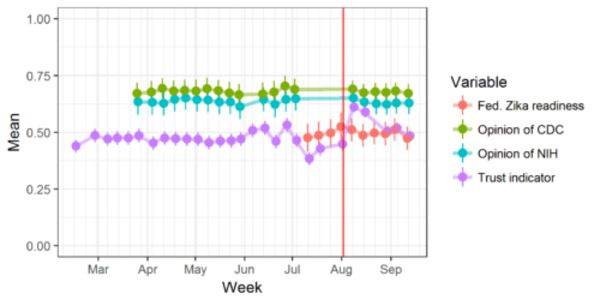
Following widespread media coverage of the trial, people paid more attention to news about the Zika virus and showed greater trust in science. The spike in public confidence in science lasted just 2 weeks, though the heightened attention to the Zika virus persisted for 6 weeks. Opinions toward the CDC or the NIH did not improve, despite the considerable increase in media representation by the directors of those agencies, nor did respondents report feeling that the federal government was more prepared to manage a Zika outbreak.
These results suggest that it is possible to increase the credibility of science when science provides uncontroversial solutions to problems covered by the media. "[C]onfidence in science could be bolstered in a more sustained fashion by regularized communication about advances made by science. These communications may be particularly effective when they provide potential solutions to problems placed by media on the national agenda. However, such effects are likely to be relatively brief even under the best of circumstances. Additionally, such communications may backfire if the public feels that a problem or its solution is overstated for the personal benefit of scientists, politicians, or the media..." So, unless reinforced, any "increases in science trust are likely to be short-lived even under the best of conditions."
Science Communication 2017, Vol. 39(4) 548-560. DOI: 10.1177/1075547017719075 - sourced from "Public Trust in Science Spiked After News Reports of Zika Vaccine Trial", July 31 Annenberg Public Policy Center news release, accessed on May 15 2018.
- Log in to post comments