










































Do We Have to Meet This Way?
The Guardian
This news article focuses on the strategy of holding face-to-face meetings, examining their value (or lack thereof). As reported here, researchers at the United States (US) Texas A&M University demonstrated that when you gather a team for a brainstorming session, the members actually produce fewer ideas than if they were working on their own. According to facilitator Steve Kaye, quoted in this article, businesses waste an average of 20% of their payroll on "bad" meetings. The implication, according to Nicholas Kohn and Steven Smith of Texas A&M, commenting on their article (published in the journal Applied Cognitive Psychology, March 29 2010): "Assuming it is desirable to have a wide variety of ideas or solutions to a problem...one should split up the brainstorming group into non-interacting individuals, avoiding a group session."
The "productivity deficit" that Kohn and Smith identify in meetings is partly the result of what they describe here as "social loafing". Also, meetings "are often held simply because they can be called", according to an American blogger known as the Jackal, whose "corporate survival guide" Hostile Work Environment focuses on the hours that he feels are wasted in the name of decision-making and information-gathering: "A person with the power to call a meeting often does so to display that power," the Jackal maintains. "Generally speaking, these meetings are a complete and utter waste of time, with bad leadership, badly defined goals, no real agenda and lots of people speaking out of turn for self-validation. In my humble opinion, 90% of the time in today's corporate world calling a meeting is an abuse of power."
Belfast, Ireland-based consultant Ken Thompson, who spent 30 years in industry and now focuses on teamwork, reflects here on his time as head of Information Technology (IT) at Reuters, saying: "Typically there's a point during a meeting where a manager gives somebody a really hard time because their bit of the project's not going well. And everybody thinks, 'I don't ever want that to happen to me.'" Also, as reported in this article, there are managers who call meetings to: pass on messages that could just as easily have been sent by email, rubber-stamp decisions they have already taken, to fill time, and/or to have some face time with their colleagues. Thompson asserts that in 10 or 15 years the very idea of physical meetings will be a novelty. Even now, he says, it is entirely possible to conduct most business arrangements virtually, as long as you meet in person now and again.
Various strategies for keeping what face-to-face meetings that do occur "fresh" are offered here. For example, Susan Docherty, who leads the United States (US) sales team at General Motors, changes chairs between meetings "because being disruptive, and not always being predictable, is healthy", and Richard Anderson, chief executive of Delta Airlines, has a bell for team members to ring when the debate gets too heated. As reported here, when caught in a face-to-face meeting, the Jackel (see above) says, "It's all right to be quiet at a meeting and just observe."
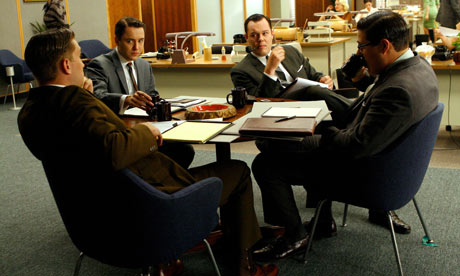
Guardian website, May 5 2010. Photograph: Everett Collection/Rex Feature
- Log in to post comments