










































Design Thinking and Participatory Video in Narino, Colombia
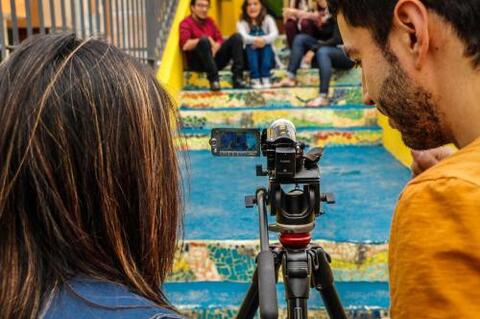
At the request of the Centre for Social Innovation in Nariño (CISNA), in March 2017, InsightShare (United Kingdom) worked with the d.school Paris (France) to carry out a series of trainings and workshops based on a combination of design thinking (also known as human-centred design, or HCD) and participatory video (PV) in Nariño province, Colombia. The motivation of CISNA, an organisation established by newly elected young Colombia governor Camilo Romero, was to strengthen and support a local "culture of social innovation" through the initiative.
PV is a methodology that is meant to provide an accessible way to bring people together - irrespective of literacy, background, gender, or age - to explore shared issues and voice concerns. According to project organisers, it can be a powerful platform to engage and mobilise traditionally underrepresented and underserved groups. PV is designed to simultaneously empower participants to engage in learning activities and voice their stories and opinions, whilst they gain confidence in their abilities to acquire new skills, improve existing knowledge and practices, and think creatively towards innovative problem-solving.
In this project, PV is being used as a tool in the process of design thinking, a creative approach to problem-solving that begins with the people one is designing for and ends with new solutions that are tailor-made to suit their needs. It consists of 3 phases:
- Building understanding and empathy with those who will ultimately be the users of any new social project, service, or product that is developed - InsightShare has found that PV can help to engage the intended groups from the start and hand over control, enabling them to turn the camera on themselves to identify constraints, opportunities, and needs.
- Generating ideas - Here again, PV helps bring in diverse voices, identify locally workable solutions, and reach out to groups that won't usually come to workshops.
- Developing and testing the ideas, both in the community and with other key stakeholders - This is what is known as prototyping and is critical in breaking cycles of passive dependency or hopelessness and in creating a movement towards local action and positive change. Sometimes these prototypes are in the form of a role play or short PV that conveys the new experience, service, or product to other community participants or "users", so they can start to imagine how this might improve their lives or address some of the day-to-day challenges they are facing. The video element enables these solutions to be shared widely both within the local community and with broader stakeholders and decision makers. All this time, the "users" (who are now co-designers) are collecting feedback and refining and testing their ideas until they are ready to be implemented.
InsightShare and the d.school team coached CISNA staff in the use and facilitation of a design thinking workshop among a group of about 30 participants, all working on different social innovation projects in the capital of Nariño, the city of Pasto. The challenge was, "How can CISNA support a thriving environment of social innovation in Nariño?" Those who attended were all young leaders involved in social projects such as an urban cycling project, art projects, urban dance projects, and projects addressing teenage pregnancy. The design thinking workshop featured a combination of brainstorming, analysing, and team building exercises. Often working well into the evenings, the participants felt that the hands-on methodology could bring them greater clarity in their work. By following this process together, new ideas were emerging. One challenge was called "reverse brainstorming", which aims to find the worst possible response to an emerging issue that has been identified, and then reverts these back into positive actions and responses.
At the end of the second day, some products and services had been designed and were ready to be tested and implemented in real life. Examples include: a step-by-step manual (called "Manuel"!) on how to identify opportunities for funding a social innovation project; a detailed structure for an online platform where users can find other local projects; regular meet-ups to discuss shared challenges and promote each other's work; and a social innovation contest where the grantees would receive an incubation period with the government in order to close the gap between the citizens doing projects and the government.
The next phase of the initiative involved workshops with indigenous leaders and teachers from various groups that were all part of the Los Pastos indigenous community in Nariño. The 30 groups, which are spread across the Southern parts of Colombia and the Northern parts of Ecuador, are engaged in a long struggle to reclaim their ancestral lands and to prevent the loss of their indigenous culture, values, and language. The aim of bringing the design thinking project to them was twofold: to develop a PV needs assessment process that CISNA could replicate across the whole territory, and to build links with the local indigenous communities and explore how CISNA could support these harder-to-reach groups in developing their own social innovation initiatives.
Reportedly, 3 groups worked until midnight experiencing engaging and fun PV games that introduced the group to the camera, enabled them to try out interview techniques, and focused on developing trust and understanding between the participants and the facilitators. The next day, participatory activities helped the group identify specific problems in the region that affect their communities. Topics that came up included their pride in their indigenous culture and specifically their struggle to include indigenous beliefs and values in the centralised educational curriculum (so-called ethno-education). Topics also included the struggle these groups have been through over the years, especially in the light of the Colombian conflict. As they started to group all the issues and topics, they noticed that whilst many of them had identified their big struggles to secure their land, education, and culture, hardly any of them had mentioned the important issues that were closer to home, such as alcoholism and family breakdown. They decided that one group should focus their video on these "closer to home" issues. A second group focused on the issues related to land, and the third group focused on the ongoing struggle for indigenous education. (New Internationalist subsequently published their story here.) Their video messages are primarily aimed at key decision makers in the government; however, the participants envision their videos as tools to promote positive change within their communities. According to organisers, PV had helped the groups identify problems and solutions in new ways, creating safe spaces for discussion.
Participatory Media, Indigenous Culture
CISNA invited InsightShare and the d.school Paris to carry out these trainings following their work combining these methods in marginalised estates in the suburbs outside Paris (Val Fourré). That project, carried out in partnership with the engineering university École des ingénieurs de la ville de Paris (EIVP), sought to ensure that local citizens became the urban planners of their own environment. They worked through some of the key issues they face and developed ideas and designs that are now being considered and integrated into decision making by the local council and social housing coops who commissioned the work. Of the project, Anaëlle Liberman, CEO Cogicité and Professor at EIVP, said, "By giving citizens the cameras and enabling them to represent themselves and their environment in their own way and their own words, we managed to carry out deep and meaningful participatory design thinking work. This was all the more remarkable given that this is an area that is known for its distrust of outsiders."
According to organisers, using PV helped CISNA communicate that the organisation is ready to listen and make a meaningful connection with the indigenous population who, after so many years of struggle, are understandably very wary of working with outsiders and with the government. Having witnessed the PV workshop and after speaking with the participants, Ernesto Ramiro Estacio, a Pastos indigenous leader and currently environment secretary for the government of Narino, declared: "you have earned our trust and now you are part of our community; we are ready to work together".
The results from both the above-described workshops were used as a starting point for the "Citizen Lab" that took place in Pasto in October 2017, funded by the United Nations with the Narino Government and led by SEGIP (Secretaria General Iberoamericana - Madrid). Youth leaders and participants from the indigenous teachers group shared the insights they collected through PV with other workshop participants, who gave suggestions for building on the solutions and actions they identified and possibly even developing new prototypes.
InsightShare, d.school Paris, CISNA
"How to make an impact - design thinking meets participatory video", by Chris Lunch with Manon Koningstein, September 1 2017 (accessed on June 11 2018) - sent via email from Chris Lunch to The Communication Initiative on April 11 2018.
- Log in to post comments