










































CREDIBLE VOCES de la Juventud: Media Literacy in Latin America and the Caribbean
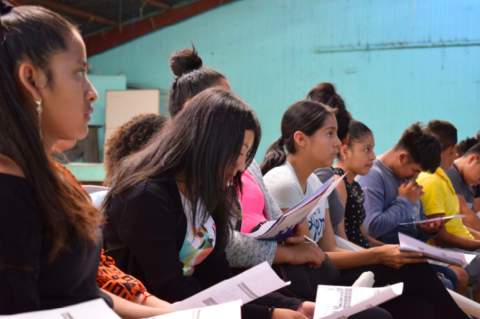
CREDIBLE VOCES de la Juventud (Credible Voices of Youth) is a five-year project (October 2021 - September 2026) that seeks to build media and digital literacy amongst youth and encourage local media and the broader information space to feature more youth voices and perspectives. The accomplish this, IREX is working with four organisations across three countries - Guatemala, Peru, and the Dominican Republic - to develop local approaches and empower local actors to address informational challenges in their own societies, create resilience to mis- and disinformation, and encourage more informed, productive, and inclusive civil discourse. The project is funded by the United States Agency for International Development (USAID).
The project is based on the idea that youth are a tremendous force for positive, transformational change in the information space - they readily engage with information, innovate, and act with greater agency, visibility, and voice. With this in mind, the focus of the programme is to ensure that:
- Youth and other local actors have improved digital and media literacy skills and promote positive community social norms that support informed political participation and civic engagement.
- Local media, particularly young journalists, and local youth influencers, are engaged with their communities, produce quality content, and lead others in positive local norms around civic responsibility, civic engagement, and information.
To achieve its goals, CREDIBLE brings together four local implementing partners, one each in the Dominican Republic and Guatemala and two in Peru. Each partner plays a role in ensuring media literacy initiatives are impactful and tailored for their context. Supported by IREX, the partner organisations are enhancing their capacities to build local social capital through informed youth engagement and digital citizenship, ensuring long-term gains within the communities they serve. Through the implementation research and learning agenda developed under CREDIBLE, partners are also empowered to provide youth-led and youth-focused media and digital literacy (MDL) programmes, equipping them to sustainably achieve community resilience outcomes in the long term.
Each partner comes with its own strength and area of expertise, which will encourage the sharing of different perspectives and approaches and create broader learning opportunities between partners. The partners are:
- Entrena in the Dominican Republic, a social entrepreneurship company founded in 1982 and specialising in social development, education, youth, private-public partnerships, and sustainability. Entrena has been a local partner with USAID since 1992. Under CREDIBLE, Entrena is co-creating and scaling interventions with 11 youth-driven social development hubs serving vulnerable youth.
- Paz Joven in Guatemala, an organisation founded in 2005 and led by and for youth to promote youth capacity building on both the regional and national level. They support youth in citizen participation through a network of volunteers in 12 regions and 60 municipalities in Guatemala. As part of this project, Paz Joven is elevating the voices of a vibrant and diverse network of young leaders in local communities across the country.
- CEDRO, a Peruvian organisation in operation for the past 35 years. They focus on welfare, health, prevention, and development promotion, with experience in communications, digital inclusion, and work with young people. Cedro operates in 39 communities across Peru, working in close coordination with local government. Under CREDIBLE, CEDRO is galvanising the support of youth coalitions across Peru to consolidate interventions around the formal education on digital civics.
- Laboratoria, an organisation that started in Peru and has since expanded operations to Mexico, Colombia, Chile, and Brazil. They offer a 6-month tech bootcamp to teach young women the skills they need to be employed as frontend and UX developers. Laboratoria is mentoring networks of young women equipped with media and digital literacy skills as they form a more diverse and inclusive digital economy sector.
The implementation of the project follows the following key approaches:
- Active listening and iterative learning and scaling - CREDIBLE combines a youth-led, adult-supported approach to developing youth assets and agency, promoting youth contributions and improving the enabling environment. The idea is that once partners can scale media and digital literacy skill-building, they will spark multiplier effects within their beneficiaries and communities at large.
- Diverse youth represented - Youth Steering, Oversight, and Leadership (SOL) teams in each country work to ensure diverse and gender-balanced support to programme design and offer guidance on the adaptation and scaling of media and digital literacy and content production initiatives.
The programme is also leveraging IREX's approaches such as Learn to Discern (L2D), the Vibrant Information Barometer (VIBE), and Organizational Performance Improvement (OPI), adapting them as needed with the Latin American partners (see Related Summaries below for more information). Learn to Discern is a methodology designed by IREX to help citizens detect and resist the influence of misinformation and propaganda by: enhancing citizen capacity to detect censorship, question and verify expert credentials, identify hate speech, avoid emotional manipulation, and verify news sources and content. VIBE is an index developed by IREX to capture and diagnose the challenges and opportunities of today's complex information systems. It is designed as a tool to track national and regional information trends over time and to inform global understanding of the way information is produced, shared, consumed, and utilised in the digital age.
Backed by the iterative learning and scale-up approach of the project, activities implemented by the partners follow a series of steps:
- Co-design: Partners work to develop models of individual and community resilience building and produce information relevant to youth.
- Test: Partners implement different models to build resilience and increase youth-relevant information.
- Learn: Youth collect disaggregated data and then review, analyse, and share results across the programme.
- Adapt: Youth adapt interventions based on innovation, research from the relevant fields, lessons from design, and testing in different contexts.
- Scale: In-country scale-up will be led by youth and partners. In addition, scale-up will take place as partners act as trainers and mentors to new partners in additional countries.
To date, the project has had various consultative and onboarding meetings with its partners and other stakeholders, conducted trainings with partners, started organising research around information needs and gaps, co-designed a learning agenda, and developed a communication strategy for partners.
Youth, Media Development
- Low news reliability, increasing use of social media, and low trust in governments have enabled foreign and domestic actors in Latin America and the Caribbean to undermine democratic principles through information influence operations.
- Disinformation has an outsize impact on youth. Youth are the most active users of social media and messaging platforms and use these platforms as their principal source of information.
- Constant exposure to complex and coordinated disinformation campaigns, hate speech, and polarising politics are leading to heightened social discontent and decreased civic engagement among youth, with many retreating into online echo chambers, detached from their communities.
IREX website and CREDIBLE VOCES de la Juventud Quarterly Progress Report, USAID [PDF] on August 1 2022. Image credit: IREX
- Log in to post comments