











































COVID-19 Response in Northwest Syria: Innovation and Community Engagement in a Complex Conflict
Kings College London (Ekzayez, Meagher, Patel); Syrian Public Health Network (Ekzayez); Idleb Health Directorate (al-Khalilm Alzoubi); Early Warning and Response Network, or EWARN (Jasiem); White Helmets - Syria Civil Defence (Al Saleh)
"Gaining trust and legitimacy are important lessons from the previous polio outbreak in Syria and from the Ebola outbreak in West Africa..."
As a result of protracted armed conflict that began in 2011, Syria's weak health system is neither prepared nor able to deal with normal health needs, let alone the predicted spread of COVID-19. In opposition-held Northwest Syria, where the World Health Organization (WHO) has limited capacity to engage, bottom-up local governance technical entities are playing a key leadership role in pandemic preparedness and response. This article explores how, in light of a lack of capacity and resources, the health system in northwest Syria is using community-driven approaches for the containment of COVID-19.
Surveillance of disease, including COVID-19, in all territories outside the control of the Syrian government is covered by the Early Warning and Response Network (EWARN), which was established by a Syrian non-governmental organisation (NGO) in 2013. The EWARN was able to share the initial alert for the first case of polio in eastern Syria in October 2013. The Polio Control Task Force, which resulted from coordination efforts between United Nations (UN) agencies, the WHO, and international and local NGOs, led the response. In addition, the polio response necessitated establishing core vaccination structures with wide networks of volunteers to reach every household in the region. A similar approach has been adopted for the COVID-19 response, with a task force operating from Turkey, a central field coordination mechanism in Idlib, and investment in local volunteers.
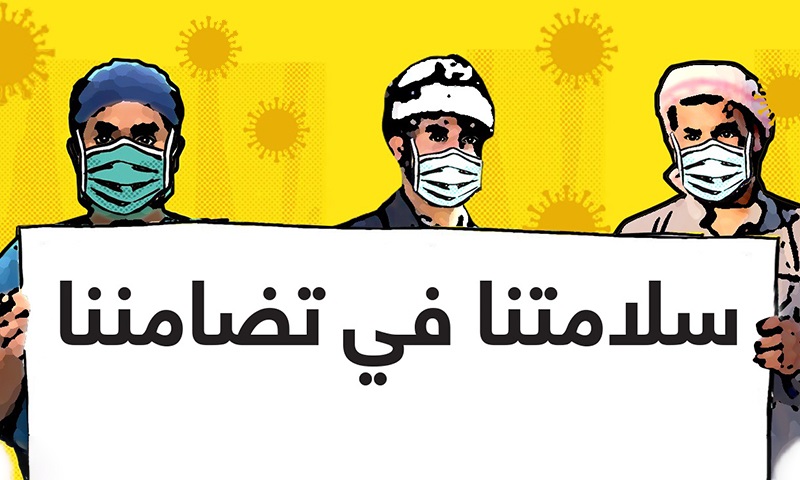
For instance, as the technical health authority in the region, the Idleb Health Directorate (IHD) has created a grassroots governance system and is working with local actors such as the White Helmets (Syria Civil Defence) to mobilise thousands of volunteers in light of COVID-19. Specifically, Volunteers against Corona utilises social media (e.g., Facebook), free cloud web servers, and WhatsApp communication to communicate with various technical teams and neighbourhood committees about their efforts - e.g., to raise awareness, conduct disinfection campaigns, and facilitate community-based referrals. (IHD also has dedicated a WhatsApp number to respond to queries from public on COVID-19.)
Social media has also been a tool in fostering connections among a wide network of Syrian medical diaspora, especially in the United Kingdom (UK) and France, who are providing the local health system with the latest evidence on SARS-CoV-2 virus. A central medical chat room has been established on WhatsApp, where relevant information is shared on daily basis. Several online remote training sessions are provided using a variety of online platforms, and a repository of online resources, educational materials, and training packages has been established for use by field health workers in remote areas of the region.
Furthermore, the first author of this paper was involved in developing an Arabic speaking website to facilitate self-assessment for COVID-19 for the population of the northwest Syria. It involves an algorithm that classifies users into five categories depending on the level of disease suspicion and the presence of risk factors or complications, advising users to follow certain recommendations or to access certain services. The website was developed in coordination with a local Syrian NGO called Violet Syria, which has been involved in various social mobilisation activities related to COVID-19. The organisation has coordinated with local groups to advise communities to use the website for initial self-assessment. The aim is to reduce pressure and overload on the already-stretched health system in the region.
Social distancing measures and school closures in Syria have been challenging, considering the high poverty rate, high population and household density, and some social and cultural practices that involve large numbers of people, such as funerals and congregational prayer. Engaging with various local actors, including the local councils, community and religious leaders, has been key to overcome some of these challenges. Health and local NGOs have engaged in various public awareness activities, including distribution of more than a million educational materials, such as leaflets and brochures, household visits in camps, and radio messaging.
As of April 28 2020, there had been 43 confirmed cases of COVID-19 in Syria's government-held areas, and no confirmed cases of COVID-19 reported in northwest Syria. However, the local health authorities in the northwest Syria transparently say they cannot confirm that the region is free of cases given the limited testing capacity. In this context, the authors conclude that protection of health workers should be a core principle in designing the COVID response, and the WHO should mobilise more resources to scale up the capacity of the health system in northwest Syria.
Journal of Public Health, fdaa068, https://doi.org/10.1093/pubmed/fdaa068. Image credit: Volunteers against Corona via Enab Baladi
- Log in to post comments