










































Countering Vaccine Hesitancy through Immunization Information Systems, A Narrative Review
University of Perugia (Gianfredi, Moretti); University of Pisa (Lopalco)
"Developing and improving IISs could represent one useful tool to improve communication, confidence and convenience on immunization programs."
The aim of this review was to explore the advantages of the use of an immunisation information system (IIS) as a tool to counter vaccine hesitancy (VH). IISs are confidential, electronic population-based systems storing individual-level data on vaccines received within a given geopolitical area. Each of the aspects of IIS is discussed in reference to the 3C model, which emphasises complacency, convenience, and confidence as factors that can influence parents' complex decision-making process on immunisation.
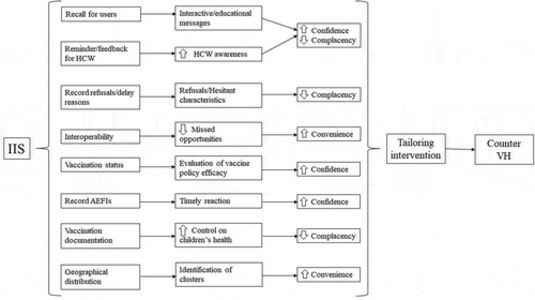
Conducted in June 2016, the literature review focuses on the following aspects of IIS in the context of VH:
- Automatic reminder/recall: 21 articles focused on reminder/recall and the IIS. One of them, which examined flu vaccine coverage in children (aged 6 months - 17 years) who were not vaccinated, compared the impact of (i) an educational and interactive text message, (ii) educational only text-message reminder, and (iii) the usual protocol (telephone appointment reminder with general information on vaccination). The results proved the beneficial effect of text messages, especially the educational plus interactive text message (p < 0.02 compared to usual care and p = 0.04 compared to only educative text message). A possible explanation, as the authors suggested, is that the interactivity increased the sense of responsibility due to the parents' active engagement that, in the 3C model, is represented by complacency. These data and others shared in the literature highlight the role played by IIS in vaccination reminders both to parent/patients and to healthcare workers (HCWs). In short, with educational text messages, parents can improve their empowerment on vaccination and are also motivated to adhere to the immunisation schedule, while HCW can update, in real time, the immunisation status of their patients. This shows that IIS could counteract VH by increasing the number of opportunities during which hesitant parents could discuss immunisation with professionals. According to the 3C model, this could be beneficial to increase confidence and to contrast complacency.
- Assessment of vaccine refusers and vaccines recipient characteristics: Studies show how IIS might resolve issues related to identification of unvaccinated people, especially if vaccine refusals are recorded as a part of the registration process and if the IIS is connected to paediatricians or family doctors' software (electronic medical record systems). This function of IIS could be important to conteract complacency, because it could allow analysis of parents' reluctance and provide details needed to tailor vaccination campaigns. However, the opportunity to understand better the characteristics of the intended population depends on the type and quality of data recorded.
- Interoperability with other electronic registries and decision support systems: One of the possible reasons for a low specific vaccine rate (e.g., for the influenza vaccine) is missed opportunities; through this review, 6 manuscripts were retrieved and analysed. It is plausible that physicians can fail to recommend immunisations if they are not aware of vaccination status of or vaccine indications for their patients. Having this information available might increase the number of occasions in which HCWs and parents can discuss vaccinations, providing opportunities to address parents' doubts and insecurities. Indeed, offering tailored counseling is deemed important in countering VH.
- Evaluation of vaccine programme performance: IIS is a tested tool to evaluate the efficacy of vaccine policy through the assessment of changing vaccine coverage rates before and after policy interventions. Related to this topic, 22 manuscripts were included in this study. For example, Cates and colleagues assessed vaccine coverage after 3 months of social marketing experiments aimed to facilitate conversation among adolescents/parents and physicians about human papillomavirus (HPV) vaccination. They compared the data from IIS of 2 different counties (one where they performed the intervention and the other as a control), and the probability to get vaccinated was 34% higher in the intervention county.
- Possibility to record adverse events following immunisation (AEFI): The integration between IIS and the AEFI registry can help to identify new and rare adverse reactions, to recognise new potential risk factors, to verify the safety of new licensed vaccine through post-marketing studies, and to be reactive in case of suspected adverse events reported by the media, as discussed in the 24 articles presented in this review. Notably, transparency matters because the trust-building process is very complex and long, and it could be undermined in an instant.
- Social mobilisation to promote vaccine programmes: For instance, apps connected to IIS might consolidate data from multiple sources and, after an internal validation, could provide a platform where people are engaged with their own vaccine information. Moreover, apps can be consulted in all possible settings, increasing people's awareness and accuracy in vaccine rate estimation.
- Geographical distribution and clusters of vaccine-hesitant people: Increasing evidence shows a relationship between geographical clustering of unvaccinated people and localisation of vaccine-preventable disease (VPD) outbreaks. Known reasons for un-immunisation are healthcare access barriers, ethnic-religious barriers, and socioeconomic barriers. These factors are part of "convenience" in the 3C model. IIS is an instrument to assess vaccine coverage and vulnerability of unvaccinated people; moreover, it is can be an instrument for public health investigations.
Despite its potential strengths in addressing VH, IIS is not without limitations. One example is the overestimation of the denominator used to calculate the coverage rate. The number of people who moved to another state or region but remain active in the IIS could explain this. Several avenues are open for addressing this problem. For instance, reminder/recall systems can help to identify the cross-border child, the system could allow their citizens to update their own information, or an IIS interconnected with civil registries could reduce this bias.
In conclusion: "The use of IIS is a promising tool useful for both vaccine providers and vaccine recipients as well as public health policy makers and epidemiologists....It allows access to flexible analyses that cannot be done using other vaccination data sources. It is able to reduce the burden of manual paper reporting systems, to facilitate quarterly vaccine coverage reports instead of aggregate data, to increase the accuracy of the data and to track the administered doses." The results of this review show that IISs are important instruments to counter VH; nevertheless, there are not enough trials aimed to evaluate the efficacy of IIS to offset VH. Thus, further research is needed.
Human Vaccines & Immunotherapeutics, DOI: 10.1080/21645515.2019.1599675
- Log in to post comments