










































Communicating Disasters
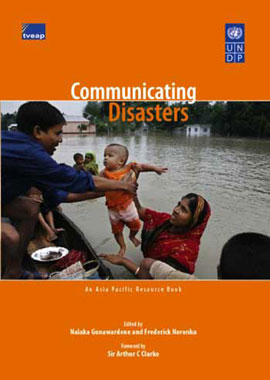
This 42-page report of a "regional brainstorming meeting" organised by the United Nations Development Programme (UNDP) and Television for Education Asia Pacific (TVEAP) summarises discussion on approaches to managing information before, during and after disasters. According to the report from the post-Tsunami reflection on communication, those managing disaster relief and those reporting on and researching the disaster can be subject to stressful communication arising from a failure to appreciate the differences in their respective needs and priorities.
The report focuses on the essential functions of information and communication in disasters, and the need to serve the public interest over individual, corporate or agency interests. The meeting, as reported here, recognised that the media must evolve its own ethics from which to establish guidelines for the purpose of using the power of new and established forms of mass media (radio, television, online and print media) to mitigate the effects of hazards and disasters.
The background discussion cites a need for media partnership with newly-installed national and international early-warning systems to disseminate information, bridging the 'last mile' with local community media. Further, it states that with capacity building, media, which already reaches most houses in Asia, can not only alert, but also prepare communities for disaster risks, raise awareness of civil society to minimise effects of disasters, and aid in coordinating relief.
The objectives of the meeting were:
- To explore the role and use of information and communication technologies (ICTs) at the time of a disaster;
- To share lessons learned based on the experience of the Tsunami disaster; and
- To come up with guidelines for engaging the mass media and new media for more effective communication at the time of disasters.
In introductory sessions, uses of communication technologies as tools surfaced in stories told about life-saving long distance telephone calls as early warnings to a few locations and the appearance of blogs, not only tracking what happened on the ground, but as a continuing venue for public comment during recovery. Panels focused on the use of communication; the divergent communication needs and resources; and briding differences in those needs while focusing on the nuanced voice of the disaster-affected people. Panel 2, for example, was on sharing the experiences of TVEAP's Children of Tsunami regional media project, which tracked on TV, video and online the recovery stories of eight Tsunami affected families in four Asian countries as a way of personalising the story beyond the news and current affairs coverage. Several programmes focused on using children in widespread locations as 'story guides,' in a personalised approach, to show specific experiences of the recovery over time, both as it progressed and stagnated.
Ideals or 'wishes' expressed by stakeholders include:
- Using more models of cooperation between media and disaster managers, such as joint assessments, co-creation of content, and journalists "embedded" in relief agencies.
- Using a community base by setting up community-centred communication channels in disaster-prone areas (radio, newspapers, theatre); sensitising managers to minority circumstances; increasing access to technical help; providing a venue for grievances; building local capacity to direct volunteers; increasing access to use of new media - blogs and visual (photo and video) uploads to the internet; and increasing live media sessions to magnify the voice of disaster-affected people.
- Building understanding and avoiding conflict between media and disaster relief agencies through focusing on the public interest; avoiding exclusion caused by the use of jargon; listening to complex answers and explaining complex answers; and having ability in local languages.
Some suggested guidelines for more effective engagement of media and emergency and disaster relief workers before, during and after disasters are a product of subsequent days of panel discussion and debate. They include in the "before" stage: create a state of preparedness, make investigative reports on institutional readiness, and build awareness through online photo libraries and existing networks such as UNiFeed.
During an unfolding disaster and immediately afterwards some suggested guidelines are: focus on the 'immediate' media - newspapers, TV, radio, web, and cell phone; work to bridge the mismatch between victims' needs and relief agencies' interest/focus; let media have access to all information and sites, without restriction; encourage active participation of affected parties in communication processes; begin assessment from the ground up; and understand that media needs to adopt an antagonistic position to make those in power more accountable.
And, finally, after a disaster during long-term recovery, suggestions include: take care of physical needs without overlooking mental disorders; focus on what exacerbates problems like ethnic tensions or regional divisions; consider issues of gender; make available "cultural" emergency relief; raise awareness of possible mismatches between available aid and community needs; and extend coverage beyond the status quo in society (e.g., male control of households and assets). In the long-term recovery, media has a role in 're-energising' the community during the recovery phase. New media can play a special role in bypassing the hierarchy. Media also has a role to play in sharing relevant stories with the community.
TVE Asia Pacific website on February 21 2007.
- Log in to post comments