











































Co-designing an Intervention to Improve the Childhood Catch-up Vaccination Process for Migrant Parents in Australia
University of Melbourne (Chau, Kaufman, Danchin, Tuckerman); Murdoch Children's Research Institute (Kaufman, Danchin, Tuckerman); City of Melbourne Immunisation Service (Holland); The Royal Children's Hospital (Danchin)
"[C]o-design enabled discussion with migrant parents, providing an opportunity to reflect, plan, and design an intervention that would be suited to their needs."
Catch-up vaccination is a personalised process through which children with missing recommended vaccinations or incomplete vaccination records are brought up to date with the vaccination schedule. Navigating childhood catch-up vaccination can be difficult for migrant parents with inadequate health system knowledge, lack of culturally appropriate vaccination information, and competing priorities during settlement. The Migrant Immunisation Access Project explores both migrant parent and immunisation provider experiences with catch-up vaccinations to identify the causes of under-vaccination among migrant children in Melbourne, Australia. Conducted by that project, this study aimed to engage migrant parents in co-designing an intervention that supports the childhood catch-up vaccination process.
Co-design is a methodology underpinned by participatory action research. This approach to research prioritises the value of experiential knowledge and acknowledges that individuals with lived experiences should be central in co-production or co-design research for service improvement.
Data were collected between June and August 2022. Eligible participants were overseas-born parents whose children had received catch-up vaccinations between 2018 and 2022 through the City of Melbourne Immunisation Service following migration to Australia. Fourteen migrant parents participated in the study, which consisted of three phases:
- Phase One (Discovery and Insight): understanding experiences and establishing key preferences for an intervention. The researchers conducted group interviews with the parents to understand their experiences and preferences for an intervention. Parents shared similar experiences: Most were unaware of the need for catch-up vaccination until childcare or kindergarten enrolment, and there was lack of information about how to complete the catch-up vaccination process. The delay in navigating this process resulted in children being excluded from childcare and kindergarten services due to incomplete vaccination; thus, parents had preferences for receiving catch-up vaccination information prior to migrating to Australia. They also shared recommendations and preferences for interventions - e.g., they suggested that interventions (ideally with content that is "simple and visual") should contain instructions for navigating the catch-up process.
- Phase Two (Prototyping): designing and developing prototype interventions. The research team designed a suite of three prototype interventions, each one containing various combinations of the features and elements parents had preferred. They included:
- The printout: a one-page overview of childhood catch-up vaccinations. It aimed to summarise the process and give parents contact details to seek further information.
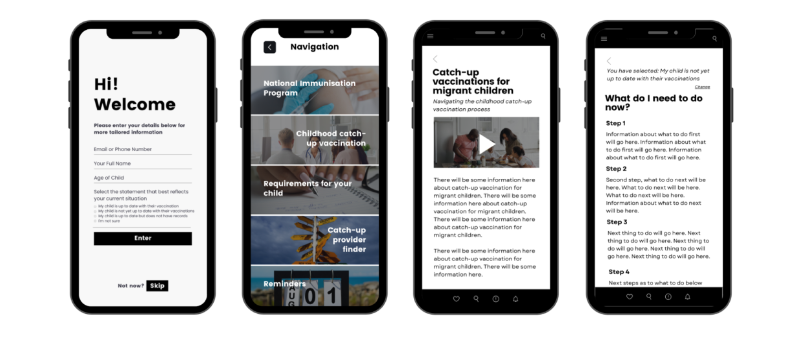
- The app: filtered information provided on parents' smartphones based on inputted demographic data. It aimed to help parents access information easily, with features such as audio and video elements, a catch-up vaccination provider finder, appointment reminders, and a built-in checklist to facilitate convenience and organisation.
- The website: more in-depth information accessible via online and digital means, acting as a "one-stop shop". It would have information including, but not limited to, the National Immunisation Program, vaccine policy, vaccine-preventable diseases, and catch-up vaccinations.
- Phase Three (Feedback): reviewing and refining interventions. The researchers conducted two additional interview sessions, with each participant attending one session based on availability. They presented the three prototype designs and prompted parents to provide comments and feedback on each design. All designs were well received. Overall, parents' top three considerations for any intervention were: (i) digital and online accessibility, (ii) inclusion of step-by-step processes outlining catch-up vaccination, and (iii) inclusion of a checklist.
In providing broader recommendations to emerge during this study, the researchers note that, for most parents in the study, general practitioners could not provide the information and assistance they sought to complete the catch-up vaccinations required for their child. Research suggests a need to support vaccination delivery in primary care, such as through provision of training opportunities that increase awareness about catch-up vaccinations and equip practitioners with relevant skills and knowledge.
Reflecting on the process, the researchers describe the co-design approach used in this study as one of its strengths. The involvement of migrant parents aided a common understanding of experiences and preferences, and the feedback on prototype intervention designs provided a deeper understanding of parents' preferences. This process "ultimately enabled the creation of a set of implementable recommendations and suggestions". Further co-design sessions could also include a broader range of key stakeholders to gain a more holistic understanding of the catch-up process and therefore, intervention requirements.
In conclusion, this study showed that a relatively simple intervention could help parents more easily navigate childhood catch-up vaccination in Australia, thereby saving time and stress. The next steps are to seek funding to pilot such an intervention to assess practicality and usefulness.
- Log in to post comments