










































Citizen Voice in Afghanistan: Evaluation of National Solidarity Programme III
Independent Consultant for Oxfam GB
Presented as part of Oxfam's Effectiveness Review Series 2014/15, this report documents the findings of a qualitative impact evaluation that used process tracing to assess the effectiveness of the National Solidarity Programme III (NSP III) in Afghanistan. Launched in 2003 by the Ministry of Rural Rehabilitation and Development (MRRD), NSP was a large effort to "build, strengthen and maintain community development councils (CDCs) as effective institutions for local governance and socio-economic development". Oxfam Great Britain (GB) was a Facilitating Partner (FP), helping to establish and build the capacity of CDCs in Daikundi province to manage local development. The evaluator explains here how he reconstructed the theory of change (ToC) for the intervention, including the outcomes it sought to achieve, and the activities undertaken that were intended to bring these about. Dr. Kinga Komorowska then explores the extent to which the intervention's key targeted outcomes materialised in the 2 groups of beneficiaries (enrolled in early versus late phases of the intervention), investigating how the observed outcome change came about, and, in light of an evidenced differences between the beneficiary groups, drew conclusions about the impact of the intervention and significance of its contributing factors.
As the report outlines, a number of strategies are used to contribute to the NSP overall objective, starting from local elections to be held in order to select Community Development Councils (CDCs). Comprehensive training modules are delivered by Facilitating Partners (FPs), designed to allow the CDCs to define their own developmental priorities in order to access funds and implement the corresponding projects (mostly infrastructural). Concurrently, the local communities are trained to monitor and evaluate projects. Finally, the CDCs are linked to developmental actors, including non-governmental organisations (NGOs), government agencies, and donors. Strategies to strengthen the transparency and accountability of CDCs' work were intended to contribute indirectly to better strategic planning at the local level, with consensus sought on development priorities among local community members. The assumption is that consensus is reached by communities coming together to discuss their problems and collectively agree ways forward.
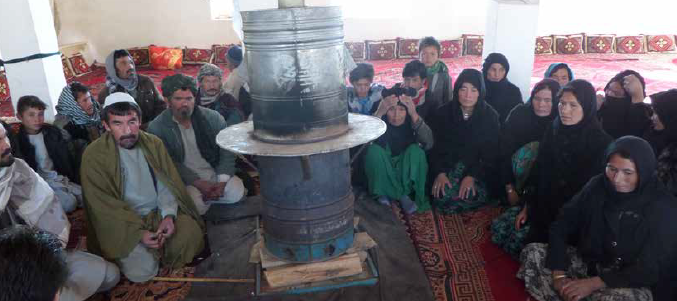
According to the report, consultative decision making is not a new concept in Afghanistan. A traditional gathering of elders called a shura can be arranged to discuss a community issue, while a jirga is called to resolve disputes. The participants in these meetings have traditionally been self-nominated elders and/or powerful and influential men who are used to make decisions on behalf of the community they claim to represent. The new approach to development being promoted by the NSP prioritises good representation and the explicit involvement of women. The idea is that fair elections must be conducted to ensure all community members have an equal opportunity to become CDC members. In addition, women's involvement in CDCs should be secured (by allocating them half of the positions) and meaningful, not just nominal. This approach is encouraged through financial incentives, with development funds conditional upon proper representation of all villagers. In practical terms, a community-wide gathering must agree the top 5 priority needs of their village before any funds are allocated for them. The expectation is that participatory governance will lead to more effective management of common resources through improved strategic planning at the local level. There is a further expectation that collaboration between CDCs to solve common problems may be required. Finally, in order to improve transparency and accountability, Community Participatory Monitoring (CPM) is initiated. CPM teams are composed of non-CDC members who monitor the NSP projects in their communities as well as CDCs' performance. Recognising that simply electing women to the CDCs may not necessary lead to their active participation in local decision making, the NSP seeks to raise awareness of women's rights and includes gender mainstreaming training designed to encourage the transformative participation of women in local decision making. The assumption is that this will lead to the political, social, and economic empowerment of women and girls.
The evaulation focused on 2 key interim outcomes that the project sought to achieve - (i) CDCs play an active role in socio-economic development and (ii) women and girls are empowered socially and economically - and exploited the phased approach to programme implementation in order to mimic counterfactual analysis by comparing governance outcomes in those communities which only recently (2014) entered into the NSP and those who started in 2010 and who have now completed the NSP intervention in order to consider the impact of the project. The final outcome evaluated: CDCs are effective institutions for local governance and socio-economic development. See the full report for details on evaluation methodologies and indicators.
The evaluation evidence suggests that the CDC plays an active role in local socio-economic development. In the villages where the NSP is already completed, 70% of respondents still cite the CDCs as the main actors of local development. The significance of the NSPs' contribution to good local governance is primarily the result of the formal conditioning of financial aid upon having proper representation of all villagers in the CDC, strengthened by readiness of traditional power-holders to transfer their authority to the CDCs, and the willingness of the local community members to collaborate with each other in setting developmental priorities. On the other hand, passive behaviour of the CDC members, as well as the low position of the CDCs among the developmental partners, poses challenges to the intended impact of the programme. Therefore, overall, the evaluation found that the NSP has not impacted on local governance as substantially as it could have.
However, the evaluation finds that the participation of people previously excluded from local decision making has increased. In particular, the NSP has formally involved women in decision making bodies, empowering them politically. Nevertheless, the formal power does not always result in real power. Therefore, the extent to which women are able to meaningfully participate in local decision making is still questionable given the evidence identified in this evaluation. In a few CDCs, the young women in the Executive Committees were faced with the daunting task of collaborating with their respective male counterparts, which significantly reduced their real influence. On the other hand, however, there is evidence that the NSP contributed to women's social empowerment as it has enabled them to attend various meetings and training sessions. Nevertheless, the possibility of women going out of their homes is not the norm in Afghanistan and the uniqueness of Daikundi (better education and openness of local women) has played a crucial role in this respect. In other words, cultural factors seem more important for women's involvement in CDCs than the NSP requirements. In addition, NSP III has not contributed to improving the low economic empowerment of women, as it did not offer any income generation activities or training. Ensuring the eligibility of income-generation projects in the next phase of the NSP, along with building market linkages, could be one of the issues for Oxfam's advocacy. It should be stressed that gender mainstreaming in the NSP has been of crucial importance for Oxfam, which not only engaged female role models (social organisers and high-profile local women), but also helped the MRRD in developing Annex K (Gender) to the Operational Manual Version Six (OM VI). In addition, the Daikundi team went an extra mile to ensure high female participation in CDC election, CDP preparation, and CDC meetings.
Dr. Komorowska explains that the NSP could be assessed as successful only if its results were sustainable. The evaluation found evidence that the CDCs shall continue after the rollout of the NSP is completed in Daikundi. Oxfam's efforts resulted in old CDCs keeping their institutional structures, meeting quite regularly and attracting the community members to the CDC meetings. The ability to build linkages with other developmental stakeholders in order to attract funding is one of the major factors contributing to CDC sustainability and one of the major value-added of Oxfam in Afghanistan. On the other hand, the findings of this evaluation suggest the further existence of the CDCs will also depend on the quality of CDC leadership. The sustainability of women’s empowerment is questionable, with a high risk of return to traditional male-dominated structure, especially in the areas that are influenced by more traditional (Pashtu) neighbours. Oxfam Afghanistan has decided to engage with the design of the next phase of the NSP programme; it appears that NSP will now be changed to a new programme called Citizen Charter. According to the report, Oxfam GB is well positioned to advise and advocate on future programme design. Although the NSP structure does not leave FPs any discretion in terms of its implementation, limiting programme learning considerations, key recommendations going forward may include eligibility of the income-generation activities (especially for women), more diversity to accommodate cultural differences between the provinces, and more flexibility in management (e.g., different staffing levels depending on the programme phase. In response to the findings of the evaluation, Oxfam is committed to collecting additional data and will integrate lessons learned from its other programming in this context in order to influence the design of the new Citizen Charter programme to ensure that women's role in decision-making at community and CDC levels is a critical component of the new programme. In the meantime, the Oxfam Afghanistan team has already planned to conduct more gender training for various CDCs, as per the request from the project's programme management unit, and as identified in this review.
Oxfam Policy & Practice website, October 19 2016. Image credit: Dr. Kinga Komorowska
- Log in to post comments