











































Assessment of Source of Information for Polio Supplementary Immunization Activities in 2014 and 2015, Somali, Ethiopia
World Health Organization, or WHO (Bedada, Gallagher, Aregay, Mohammed, Maalin, Hassen, Braka, Kilebou); Jigjiga University (Ali)
Considering that communication is considered key for the successful implementation of polio vaccination campaigns, the purpose of this study is to review and analyse the sources of information utilised by caregivers during polio supplementary immunisation activities (SIAs) in Somali, Ethiopia in 2014 and 2015. (Ethiopian Somali Regional State is the easternmost of the nine ethnic divisions of Ethiopia.) The aim was to determine which approaches could be strengthened to improve demand and acceptance for polio vaccination.
The last indigenous case of wild poliovirus (WPV) in Ethiopia was confirmed in 2001. However, thereafter, several importations were experienced from neighbouring infected countries. All cases occurred within the Doolo Zone of the Somali region, making this area vulnerable for further WPV transmission. SIAs, mass vaccination campaigns that aim to administer additional doses of oral poliovirus vaccine (OPV), are a key strategy of the Global Polio Eradication Initiative (GPEI). Somali Region has a challenging geographic terrain with rural, hard-to-reach areas, pastoralist communities, and an influx of refugees from Somalia. As part of outbreak response, Ethiopia implemented four National Immunization Days (NIDs) and 12 Subnational Immunization Days (SNIDs) between June 2013 and September 2015.
Independent monitoring of SIAs provide an objective measure of SIA quality that can be used to guide improvements to reach more children by enabling corrective action both during SIAs and in planning for the next vaccination campaign. The researchers explain that immunisation decision making is not a straightforward process for parents. The most common primary reason for non-vaccination is lack of awareness and misconception. In this regard, communication helps to provide health information to raise awareness, create and sustain demand, and encourage acceptance of vaccination services. Immunisation messages can be communicated through channels like media, health workers, town criers, drama, and songs by local musicians. The parent's source of information regarding the polio campaign, which is the focus of this analysis, is one of the key SIA indicators to be assessed by independent monitoring teams.
As part of house-to-house independent monitoring, trained data collectors gathered data from caregivers on sources of information about the polio campaign post campaign. The sources of information analysed in this paper include town criers (via megaphones), health workers, religious leaders, kebele leaders (kebele is the lowest administrative structure in Ethiopia), radio, television, and text message. The repetition of these sources of information was analysed across years and zones for trends. Polio vaccination campaign coverage was also reviewed by year and zones within the Somali region in parallel with the major sources of information used in the respective year and zones.
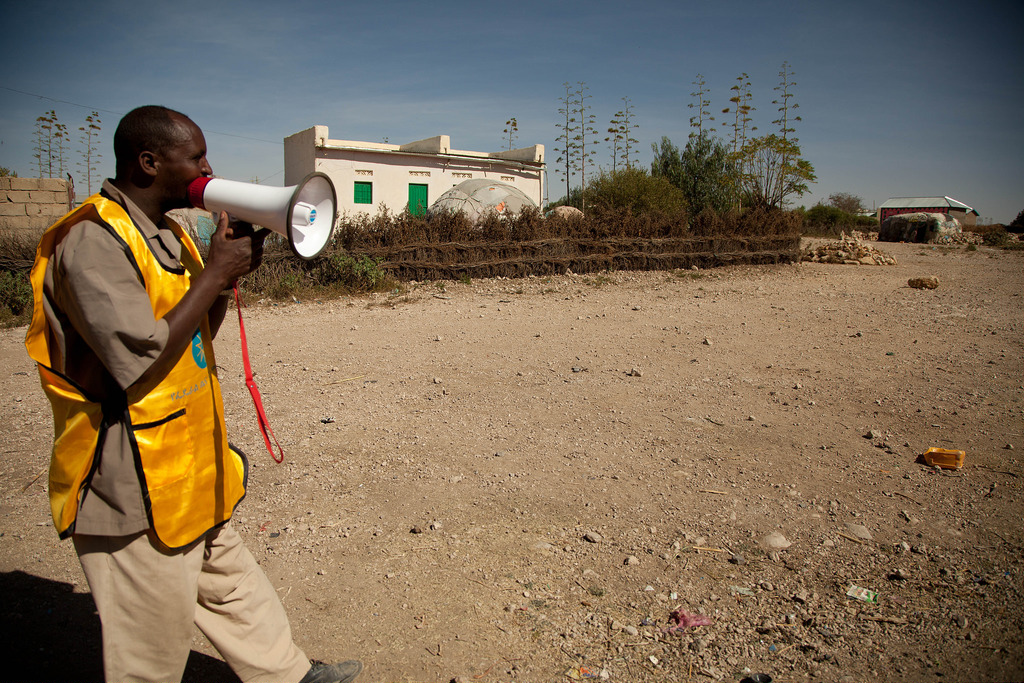
The researchers analysed a total of 57,745 responses given in 2014 and 2015 by the caretakers or parents of children targeted to receive OPV during polio SIAs. Respondents reported that the major source of information was megaphones used by town criers (37.6%). Town criers are selected from community level and are provided with a simple, translated, standard message that they broadcast using a megaphone as they move within the community, starting 7 days prior to and during the SIA implementation. Population distribution differs from place to place; hence, on average, 1,000 people would be reach by each town crier. Other major sources of information about Polio SIAs include health workers (24.3%) and kebele leaders (21.3%). Zonal trends in using town criers as a major source of information in both study years remained consistent except in two zones. 87.5% of zones that reported at least 90% coverage during both study years had utilised town criers as a major source of information, while the rest (12.5%) used health workers.
Table 2 in the report shows OPV vaccination coverage in 2014 and 2015 in relation to the major sources of information used in different (9) zones in the Somali region. Two zones had coverage of at least 90%, and the other 7 zones achieved less than 90% in 2014. In 2015, 6 zones had coverage of at least 90%, whereas 3 zones remained below 90%. Figure 2 shows the contribution of health workers, kebele leaders, and religious leaders in 2014 and 2015 SIA in mobilising people to immunise their children. Among the 3 groups, health workers had the highest contribution (24.3%) to mobilising parents and caretakers, followed by kebele leaders (21.3%); religious leaders (3.6%) were reported to have the least contribution. (The researchers explain that religious leaders' commitment may be challenged by the difficulty of accessing the population due to their scattered distribution and mobility.)
In this study, media was not at significant source of information for parents and caregivers in their decision to vaccinate their children; this may be explained by the population's low access to media in the Somali region along with the limited use of media in this region. Telephone text messaging was also found to be an infrequent source of information about the Polio SIAs. This could be due to low cell phone coverage in the region, as well as the regularity of the implementation of this method of social mobilisation.
The finding from Doolo zone that reported a fairly high number of parents obtaining information from "other" sources may suggest a potential practice that could have been adapted to that area-specific context. A further qualitative study may be required to identify what other sources of information and social mobilisation activities were being effectively used in Doolo zone.
In conclusion, the researchers learned that information provided by town criers through megaphones was cited by the majority of parents and caregivers as one of the means through which they learned about the need for OPV. They recommend that zones that obtained at least 90% OPV coverage and also used information through megaphones, as well as those who reported kebele leaders and health workers as a major source of information, should share their experience with low-performing zones. This might be helpful not only for polio SIAs but also for implementing other routine immunisation activities.
The Pan African Medical Journal 2017;27 (Supp 2):7. doi:10.11604/pamj.supp.2017.27.2.10728 Image caption/credit: Town crier in Lafaisa subdistrict, Awbare District. by UNICEF Ethiopia
- Log in to post comments