










































The Art of Knowledge Exchange: A Results-Focused Planning Guide for the GEF Partnership
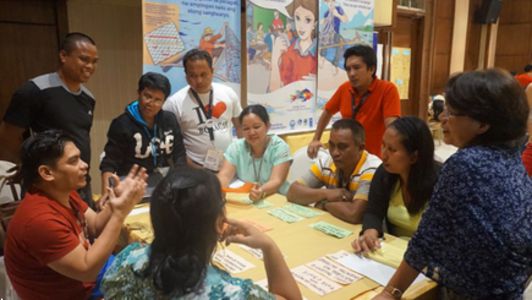
"Practitioners of environmental and sustainable development are seeing the beneficial returns of learning from the experience of others who have gone through, or are going through, similar challenges of finding working solutions. They want to be connected and have ready access to practical knowledge and proven results. When done right, knowledge exchange can build the capacity, confidence, and conviction of individuals and groups to act."
This publication from the World Bank Group (WBG) and the Global Environment Facility (GEF) serves as both a guidebook for enhancing knowledge exchange - or peer-to-peer learning - at the national, regional, and global levels. It highlights a variety of GEF case studies and examples of successful knowledge exchange in GEF projects, as well as lessons learned from implementing these initiatives for enhanced global environmental impact. (GEF funds are available to developing countries and countries with economies in transition to meet the objectives of the international environmental conventions and agreements.) The guide was produced to meet demand from GEF recipient countries for capacity building on knowledge exchange and learning, as well as in-country knowledge exchange workshops. It draws from the original guidebook, the The Art of Knowledge Exchange: A Results-Focused Planning Guide for Development Practitioners, which is in its third edition and is available in multiple languages. (Also produced was a working paper specific to the water sector, The Art of Knowledge Exchange: A Results-Focused Planning Guide for Development Practitioners in the Water Sector.)
The guidebook highlights a sample of GEF-funded initiatives with effective knowledge exchange and learning outcomes. For instance, senior environment ministry officials, scientists, and community beneficiaries in Bolivia, Ecuador, and Peru were said to have deepened trust and relationships over the span of 6 regional workshops addressing climate change scenarios and impact in key sectors: agriculture, high-mountain ecosystems, and water. "The direct results from knowledge exchange can also influence results at the institutional and even systemic levels....Participants of successful knowledge exchanges are empowered and motivated to make things happen. They seek to change the environment in which they operate, affect policies and norms that influence the way people behave, and strengthen the institutions where they work, as exemplified by the following:...Enhanced collaboration among key stakeholders strengthened the capacity of national meteorological institutions to identify protocols for information sharing and contributed to knowledge transfer among scientists on glacier dynamics. It also resulted in increased regional integration at the scientific, decision-making, and beneficiary levels."
The Art of Knowledge Exchange is the product of collaboration across the GEF Partnership, with good practice and case study contributions from the WBG, the Food and Agriculture Organization of the United Nations (FAO), the International Fund for Agricultural Development (IFAD), the Inter-American Development Bank (IDB), the United Nations Industrial Development Organization (UNIDO), the United Nations Development Program (UNDP), and the GEF Small Grants Programme (SGP). The guide offers a practical step-by-step blueprint with illustrative examples on how to design, implement, and monitor knowledge exchange embedded in projects. It also provides tools to help the knowledge broker play a more effective role in facilitating knowledge exchange and learning when designing and implementing a GEF project or programme. It reflects the experiences of various GEF partners, knowledge and learning professionals, government officials, and other practitioners who have integrated knowledge exchange into larger change processes. The guide also features the free augmented reality mobile app Blippar, a tool that enables GEF partners and others to access the guide online from around the world using their smart phones.
Table of Contents:
Introduction
- Philippines Case Study
- Honduras Case Study
Step 1: Anchor
- Step 1.1: Identify The Global Environmental Goal
- Step 1.2: Define The Institutional Challenge(s)
- Step 1.3: Determine The Change Objective(s)
Step 2: Define
- Step 2.1: Identify The Ideal Participant Profiles
- Step 2.2: Determine Intermediate Outcomes
- Step 2.3: Identify The Most Appropriate Knowledge Providers
Step 3: Design & Develop
- Step 3.1: Select The Participants
- Step 3.2: Verify The Objective And Outcomes
- Step 3.3: Organize The Design And Delivery Team
- Step 3.4: Assemble The Knowledge Exchange
Step 4: Implement
- Step 4.1: Guide The Participants Along Their Learning Journey
- Step 4.2: Orchestrate Engagement And Build Relationships
- Step 4.3: Document Implementation And Track Results
Step 5: Measure & Report the Results
- Step 5.1: Synthesize Implementation Data
- Step 5.2: Measure Results
- Step 5.3: Report Results
Art of Knowledge Exchange Toolbox
Glossary
The guide is being introduced to key counterparts in recipient countries during the Art of Knowledge Exchange Training Sessions, delivered in collaboration with the WBG, at GEF Expanded Constituency Workshops (ECWs) throughout 2017. The first of these sessions took place during the ECW for Southern Africa held in Swaziland from February 21-24 2017, where the guidebook was launched to an audience of about 80 participants.
192
GEF website, March 23 2017. Image credit: GEF
- Log in to post comments