










































after homelessness...
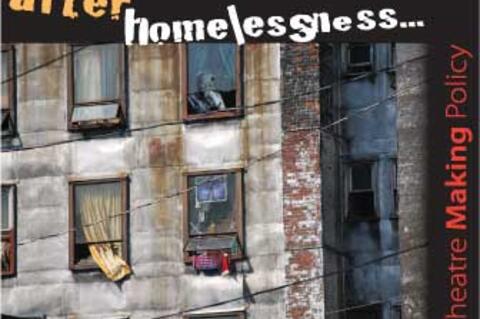
after homelessness... was, by design, participatory - involving people who are living homelessness and mental illness, issues that the organisers explain are often attached. This strategy is based on the observation that, while the finances to build affordable housing will come from governments and developers, the knowledge of what will make that housing "safe and appropriate" can only come from those people who have life knowledge of the issues.
Theatre for Living (formerly called Headlines Theatre) characterises forum theatre as an opportunity for creative, community-based dialogue. In October 2009, what was then called Headlines Theatre gathered a group of 20 participants who were paid to participate in a 6-day "theatre for living" workshop. The workshop strategy evolved from Augusto Boal's "Theatre of the Oppressed". Theatre for Living has integrated a systems-based perspective whereby a community is a complexly integrated, living organism. As part of this process, workshop participants engage in very specific games and exercises that help them investigate issues at a deep level.
After a 3-week period, selected participants joined with (then-called) Headlines Theatre to create a play. When presented to the public, this play is performed once, all the way through, so that the audience can see the situation and the problems presented. The story builds to a crisis and stops there, offering no solutions. The play is then run again, with audience members able to "freeze" the action at any point where they see a character engaged in a struggle. An audience member yells "stop!", comes into the playing area, replaces the character s/he sees struggling with the problem, and tries out his/her idea. This is called an "intervention". The process is meant to be "fun, profound, entertaining and full of surprises and learning."
The 15 "legislative performances" held in Metro Vancouver in November and December 2009 - with some tickets free to groups working on homelessness - were followed by community dialogue sessions called "housing the homeless", a series of moderated panel discussions that got at the nuts and bolts of creating safe, affordable, and supportive housing. The sessions tackled location, financing, and necessary supports and services, each day respectively. This was not a series of lectures; rather, panels were made up of people who have been homeless, Metro Vancouver City councillors, housing advocates, and business leaders, among others. The panellists shared their experience and knowledge with the topics rather than providing set answers. The solutions were sought within the conversation.
Organisers had earlier extended a call for photographs communicating homelessness. (Then-called) Headlines Theatre received 265 photos, mostly from all over Metro Vancouver. A few came from the rest of Canada and some from as far away as India, Thailand, and Mexico. Winning photographs were viewable online and were part of a group art exhibition at Gallery Gachet for the Downtown Eastside Heart of the City Festival in November 2009.
A Community Action Report (PDF), generated from this interactive process, summarises the voices of people attending the performances, voices from the Community Dialogue Sessions, the workshop group, and so on. It has been distributed to staff of the City of Vancouver and all other organisations that requested the report for their research. Other reports can be found on the Theatre for Living website.
Homelessness, Rights.
The report "Housing and Support for Adults with Severe Addictions and/or Mental Illness in British Columbia", commissioned by the BC Health Ministry, estimates that 8,000 to 15,500 adults in the province with severe addictions or mental illness are homeless, and almost 40,000 are inadequately housed. In part, Headlines Theatre points out, this can be linked to the fact that, in the 1980s, various governments started deinstitutionalising the mentally ill. The federal cost sharing for a national housing programme ended in 1993, with only 3 provinces continuing to maintain their provincial housing programmes. "In BC, welfare rates were chopped in 2002 which had a direct impact on the level of street homelessness." Headlines Theatre developed the play to approach homelessness as a community health issue - exploring how homelessness intertwines with mental health, and how the complexity of these issues requires well-thought-out housing solutions.
after homelessness... played to 93% capacity audiences and was honoured with two awards at the Jessie Richardson Theatre Awards (Vancouver’s professional theatre awards): Significant Artistic Achievement/Outstanding Innovation in Theatre as Contribution to Community (Company of after homelessness... and Headlines Theatre) and Outstanding Production (Headlines Theatre). DVDs of one of the performances are available; to order a DVD, please click here.
Headlines Theatre newsletter, sent from Dafne Blanco to The Communication Initiative on October 27 2009; after homelessness... page on the Headlines Theatre website, November 6 2009; and emails from Liza Lindgren and David Diamond to The Communication Initiative on July 23 2010 and September 12 2014, respectively.

- Log in to post comments