










































Afghanistan National Emergency Action Plan for Polio Eradication (NEAP) 2019
From the National Emergency Operation Center (NEOC), Afghanistan, this document represents an update to the National Emergency Action Plan (NEAP) as developed and continually revised by the Afghanistan Polio Eradication Initiative (PEI). In this country, one of the few remaining polio endemic in the world, the number of cases (13 in 2016, 14 in 2017, and 21 in 2018) and positive environmental samples (41 in 2016, 42 in 2017, and 83 in 2018) have increased significantly in the past 3 years. Thus, the main objective of the NEAP 2018 - to stop polio transmission - was not met.
In 2019, the PEI expects to ensure progress towards a polio-free Afghanistan by continuing to focus on identified high-risk provinces and districts. For example, the plan to conduct 3 national immunisation days (NIDs) and 6 subnational NIDs (SNIDs) in 2019 will involve inactivated polio vaccine (IPV) campaigns in polio high-risk areas, using monovalent oral polio vaccine type 1 (mOPV1) for at least 2 supplementary immunisation activities (SIAs) in high-risk areas. There will be an emphasis on improving inter-sectoral collaboration, with a focus on high-risk provinces. Work to strengthen Expanded Programme on Immunization (EPI) and convergent services will be concentrated in polio high-risk areas, particularly in the Southern region, with focus on Kandahar. Efforts will be made to improve programme quality in accessible areas (also maximising reach in inaccessible areas through constant dialogue with anti-government elements), with the main focus on high-risk provinces/districts. In addition, identification, mapping, and coverage of high-risk mobile populations, with focus on the Eastern and Southeastern regions, will continue.
Although the overall proportion of refusals is very low in Afghanistan, it is noted that in certain clusters (particularly in and around Kandahar as well as in the Eastern and Southeastern regions), the proportion of refusals as reason for missed children is high. The main reason for refusal is low awareness and misperception among communities, mainly on religious and medical grounds. Evidence from national monitoring reports shows that in some cases, use of non-local staff, involvement of young boys as frontline workers (FLWs), and lack of female social mobilisers are some of key challenges. In addition, there is room to further strengthen involvement of other sectors, including the Ministry of Haj and Auqaf, community influencers, and medical practitioners, in the process. Furthermore, community fatigue, multiple door knocking, lack of other social services, staff capacity, low staff motivation, and evidence of misbelief in the polio vaccine on the part of a few of the polio programme staff, especially in the south region, are additional challenges that needs to be addressed. Finally, there is need to further tailor communication tools to specific communities and population groups.
In short, there is a need to intensify communication strategies to increase vaccine acceptance. The programme conducts cluster-level refusal analyses and develops action plans on a campaign basis. A network of social mobilisers (SMs) and an Immunization Communication Network (ICN) has been deployed to all high-risk areas. Qualitative analysis using focus group discussions (FGDs) is being done to understand reasons of refusals, with systematic influencer engagement implemented according to local need, as well as media and social media engagement to address rumours. Specifically, the programme has planned the below interventions as part of the NEAP 2019 for areas with high proportion of refusals, such as Kandahar and Paktika:
- Operations and communications will be fully integrated at strategic planning levels but more importantly at frontline levels (ICN and vaccinator teams), ensuring that any unvaccinated child found during house visits is immediately vaccinated.
- For refusals, mapping of geographical clustering and subsequent analysis of reason for clustering will guide prioritisation and resolution strategies.
- A refusal oversight committee at national, regional, and provincial levels will be formed to track, guide, and monitor implementation and effectiveness of strategies.
- An integrated refusal resolution approach will be developed by provincial oversight committees.
- The programme will review and revise list of influencers/refusal resolution committees and enhance their interpersonal communication (IPC) skills.
- In non-government-controlled areas, the programme will explore ways to record the number of refusals to understand the extent and prioritise efforts.
- Efforts of resolving refusals in between campaigns will be intensified and documented.
- In order to minimise knocks-on-doors as well as reduce chances of false finger marking (used to indicate when a child has received the vaccine), the programme will strengthen the triage system to take off pressure from FLWs (vaccinators and ICN). SMs and the ICN will not be held responsible for resolution of chronic refusals; rather, they will be responsible for identifying and reporting them.
- To strengthen the triage system, the programme will conduct analyses on the proportion of refusals resolved by different levels to assess the effectiveness of (and to optimise) this approach.
These interventions will be supplemented by enhanced engagement of stakeholders through:
- Quarterly advocacy meetings, IPC trainings, regular involvement of Wakil Guzars (district/neighbourhood representatives), elders, line departments, and health staff, as well as ministries of: Haj and Auqaf, education, information and culture, women's affairs, and Rural Rehabilitation and Development (RRD)
- Cluster-level social mobilisation and advocacy meetings of Mullahs, teachers, and elders
- Engagement of community-based health care (CBHC), madarsas, and Juma Masjid Imams
- Engagement of influential doctors/health workers, traditional healers (Tabeeb), and polio survivors - e.g., by conducting workshops in Eastern and Southern regions
- Training of Mullahs in selected districts
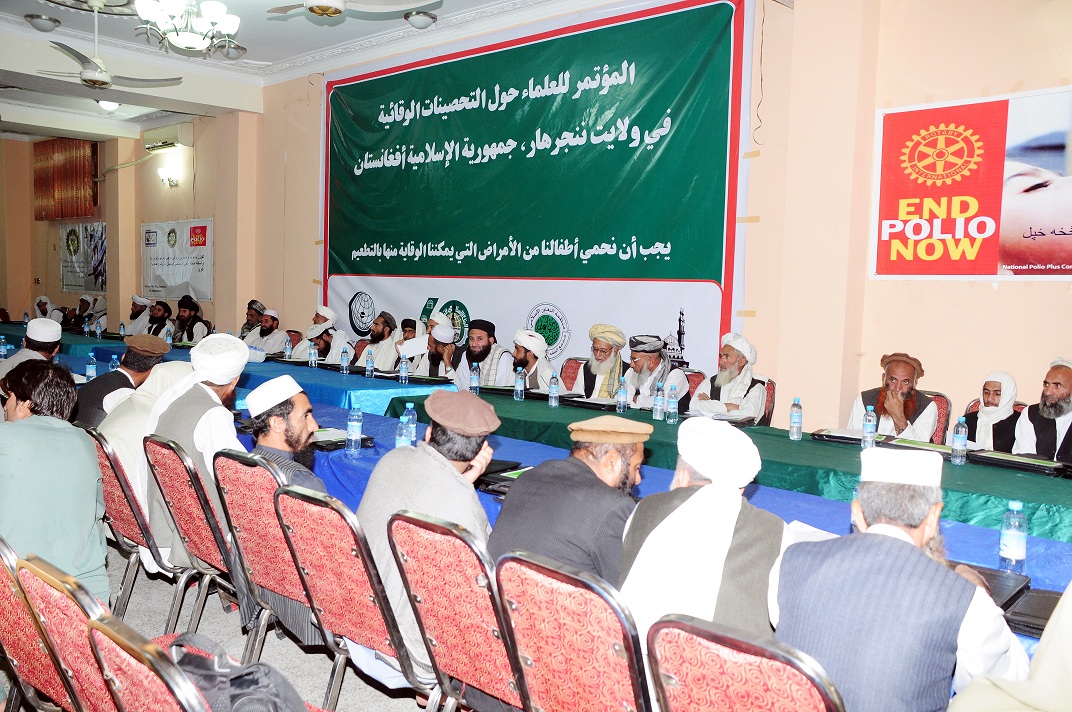
- Provincial- and regional-level Ulema conference involving the key elders and influentials from high-risk districts
An external review of the communication strategy was conducted in November/December 2018; recommendations are incorporated into 2019 NEAP and communication working group (CWG) work-plan. Priorities have been identified across the entire spectrum of communications, including advocacy, media and crisis communication, household and community engagement, and social mobilisation. Key goals of the strategy include: increasing knowledge to support positive vaccination decisions; improving polio communication coordination to increase efficiency and effectiveness of efforts at all levels; increasing community trust in the polio vaccination programme; and focusing on reducing missed children, including refusals. Activities include:
- Evidence-based messaging guide to ensure that all components of the programme are effectively communicating
- Development and training on crisis communication plan to quickly and effectively address emerging issues
- Improved coordination between NEOC and regional EOC (REOC) through monthly conference calls, regular field visits, and other activities - with a targeted workplan to enable evaluation and modification as appropriate
- Efforts to address emerging and critical communications needs, such as site-to -site vaccination and development of supportive communication tools and strategies
- Availability of tested and tailored materials to address targeted issues and priority audiences
- Strategic engagement of media for SIA-specific and ongoing support
- Revision of information, education, and communication (IEC) materials (including billboards) to address campaign fatigue
- Integrated engagement strategy to convert anti-vaccine influencers (religious leaders and medical doctors)
- Convergence activities that are embedded in all communication plans, including routine immunisation (RI), as appropriate
- Community mobilisation/sensitisation that is not only campaign based but that continues on a regular basis through IEC and print and electronic media talks and conferences
- Increased use of social media/radio for targeting chronic refusals and anti-polio propaganda
- Gradual merging of RI and PEI as a unified communication strategy
Planned improvement in the operations of the ICN include the following social mobilisation and community engagement activities: (i) continued deployment based on standard operating procedures (SOPs), with a focus on risk categorisation; (ii) technical shifts to overall missed children, including absent children tracking with follow-up vaccination during the catch-up week; (iii) intensified cluster-level profiling and planning, with focus on Kandahar; (iv) movement of two-member team districts to regular ICN with female recruitment (where possible); (v) strengthening of the application of management tools for selection and accountability in the field; and (vi) continued efforts to fully integrate ICN with vaccination teams.
Tailored social mobilisation and community engagement activities include:
- In the Southern region, for example, mobile religious teams will expand numbers in districts and improve capacity through dedicated training.
- In the Southeastern region, for example, the plan is to increase coverage of influencers in non-ICN districts that have increasing numbers of refusals.
- In the Eastern region, for example, the Refusal Response Team will be expanded, if necessary, to include a respected doctor, community influencer, and ICN member to conduct house-to-house refusal negotiation.
A chart on page 22 shows the consolidated results of the communication review and the way forward.
The NEAP implementation status and effectiveness of strategies will be reviewed in July 2019, and changes will be made to address new challenges and enable mid-course corrections, as necessary.
Image credit: World Health Organization (WHO)/Regional Office for the Eastern Mediterranean (EMRO)
- Log in to post comments