










































Action for West Africa Region - Reproductive Health (AWARE-RH)
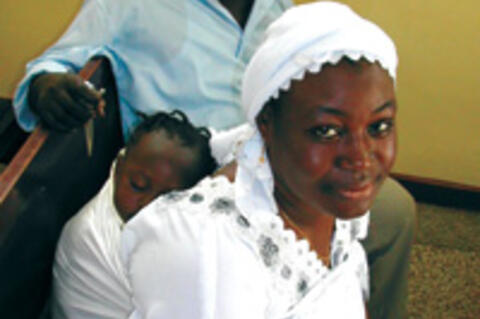
AWARE-RH is premised on the notion that improving public health outcomes requires that people change certain behaviours, and that governments have a responsibility to ensure that progressive policies and adequate resources are available and in place to support such behaviour change. Thus, a core commitment of the project is to engage key stakeholders in developing advocacy strategies to sustain behaviour and policy change that will improve maternal and neonatal health across West Africa.
One of the ways in which AWARE-RH supports West African countries and governments to allocate more resources for maternal and neonatal health services is through the REDUCE advocacy process which highlights the negative economic impact maternal and neonatal mortality and morbidity can have on a country. REDUCE is an advocacy tool originally developed by the Academy for Educational Development (AED) to stimulate policy dialogue and strategic planning on maternal health and safe motherhood. For example, in August 2005, the AWARE-RH project in collaboration with WHO funded and provided technical assistance to Burkina Faso's Department of Family Health (DFH) and its local partners to apply this tool in their country's context. Over the course of two weeks, AWARE-RH and WHO assisted members of a DFH team as they collected and reviewed information on health and obstetric factors, and used computer models to estimate the consequences of poor maternal health. Together the team used this information to prepare an advocacy plan, which included an advocacy presentation containing key arguments pointing to the need for increased funding and improved policies for maternal health. On their own initiative, the Burkina Faso team also developed a brochure with these key arguments to use in their advocacy efforts. The Burkina Faso team presented their results at an advocacy event which included media, high-level government officials, members of civil society, and other multilateral institutions and donors. After the event, the team continued to advocate for more funding and better policies by presenting the results to other high-ranking members of the Ministry of Health, Finance, and other ministries as well as to members of parliament.
To cite another example of AWARE-RH's efforts to strengthen partnerships for better health, AWARE-RH responded to the West Africa Health Organization (WAHO)'s call for data on each country's respective efforts to improve maternal health. AWARE-RH joined that subregional body in creating a cohesive questionnaire that could assist in identifying policy gaps, focusing advocacy efforts, and moving the policy agenda in maternal and neonatal health forward. Then, WAHO developed 3 resolutions with the hope of rapid adoption and implementation by health ministers at the country level. With technical support from AWARE-RH, WAHO organised a subregional advocacy training featuring AWARE-RH's computer-based advocacy tool.
AWARE-RH has facilitated a participatory process that includes an organisational assessment of strengths and weaknesses and involvement in developing detailed plans to address key issues. Specifically, the process consists of the following steps: assessing key technical and management issues as part of a participatory process; prioritising challenges to organisational effectiveness, followed by strategic planning to address these challenges; implementing strategic plans, with assistance and training from AWARE-RH; and receiving ongoing mentoring and coaching from AWARE-RH throughout the implementation process.
AWARE-RH uses a comprehensive approach to assist governments in developing their national family planning strategies. With its commitment to stakeholder engagement, AWARE-RH first convenes a meeting of representatives from government offices, family planning associations, social marketing agencies, media outlets, and key technical assistance agencies. The representatives are then encouraged to discuss and agree upon the same guiding principles of contraceptive security. Following this initial stakeholders' meeting, the country's contraceptive security committee takes a series of steps to refine and finalise their strategic plans. Equipped with these plans, the committees can solicit government and donor funds, while raising national and regional awareness of family planning needs.
One strategy has been to actively involve the "new" generation of health journalists as maternal and neonatal health stakeholders and advocates for change. For example, in July 2007, AWARE-RH, in collaboration with the World Health Organization (WHO) Africa Regional Office, brought 20 journalists and 8 WHO experts together from 8 different countries in the West Africa region to increase the number of stories on maternal and neonatal health, improve the content, and inspire journalists to become powerful advocates for these issues. At the beginning of the workshop, the participants received background information on why women and children in the subregion are dying and how such death and disability can be prevented. Expert facilitators also gave tips on how to effectively report on maternal and neonatal health issues. Journalists then visited health clinics throughout Niamey, where they interviewed fathers, mothers, and health care workers, and developed stories on different aspects of maternal and child health.
Community mobilisation is also used as a strategy. For example, even as Mauritania's Ministry of Health is taking charge of clinical trainings, AWARE-RH's safe motherhood programme continues to encourage communities to take responsibility for pregnant women, ensuring their health and the health of their unborn children. Community outreach in towns and villages is designed to alert everyone - women, their husbands, and village elders - to the signs of healthy and unhealthy pregnancies, the benefits of antenatal care, and the importance of having money and transportation arranged for pregnant women to deliver at a health centre. To do this, AWARE-RH partners with Mwangaza Action, a regional organisation based in Burkina Faso, to conduct informational and motivational campaigns about safe motherhood in the district of Kaedi. Concurrently, the Ministry of Health is scaling up awareness activities about safe motherhood in rural districts where clinical trainings have taken place. Such initiatives have led several villages in Kaedi to buy into a health savings system, in which members save for the anticipated costs of obstetric care (including transportation).
Health.
According to organisers, every day in West Africa, approximately 225 women and 1,200 newborns die from complications in childbirth, and another 4,500 to 6,500 women survive with life-altering disabilities, such as infertility and incontinence. A majority of maternal deaths occur as a result of treatable and preventable conditions such as hemorrhage, infection, eclampsia, and prolonged labor. Environmental factors, such as poor access to quality emergency obstetric service, also contribute to maternal death and disability. "While most maternal deaths are clearly preventable, maternal and neonatal health programs remain severely under-funded in Burkina Faso and in other West African nations."
United States Agency for International Development (USAID), the United Nations Children's Fund (UNICEF), EngenderHealth, Abt Associates, Academy for Educational Development (AED), Management Sciences for Health (MSH), World Health Organization (WHO).
AWARE-RH website on May 16 2005 and January 30 2009.
Comments

cAN YOU ADMIT epag AS ONE OF YOUR PARTNERS IN GHANA. OUR ADDRES IS envprotass@yahoo.com
- Log in to post comments