










































100 Days of the Polio Outbreak Response: Special Report on Papua New Guinea
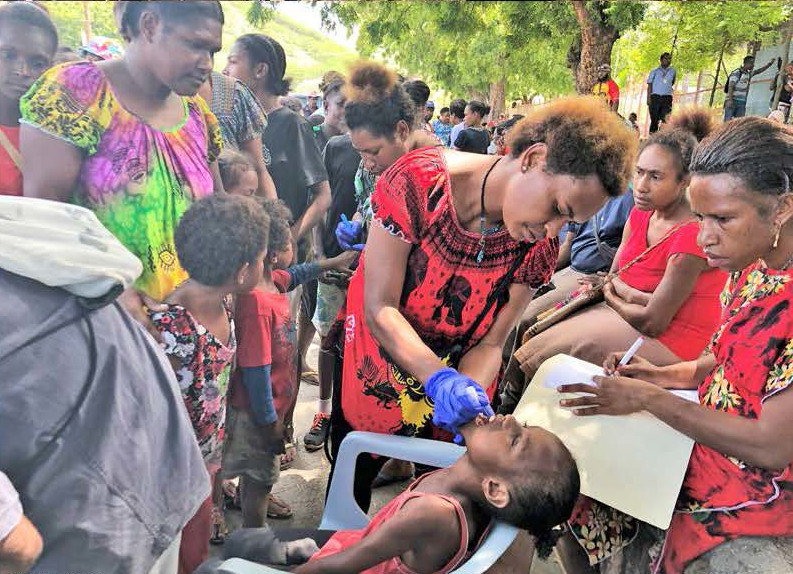
"Communication and community engagement had been a key pillar of the response operations."
To mark the 100 days since the Government of Papua New Guinea (PNG) launched the Emergency Response to the Polio Outbreak, the National Department of Health, with support from the World Health Organization (WHO), the United Nations Children's Fund (UNICEF), the Global Polio Eradication Initiative (GPEI), Rotary International, and the Bill & Melinda Gates Foundation released this report on the key accomplishments and highlights from the response operations. The below summary focuses on the communication elements of the strategy and experience.
To begin, the report puts a face and a name to the "first polio case in Papua New Guinea in 18 years" that was reported in the national and international media in late June 2018. (A public announcement was made on June 25 2018; on 26 June, the Government declared a national emergency, and the National Emergency Operations Centre (EOC) for Polio Response was activated the day after.) It was early morning in late April 2018 when 6-year-old Gafo started experiencing symptoms; it was confirmed that vaccine-derived poliovirus type 1 (VDPV1) was the cause of his paralysis, and it was later discovered that the virus was circulating in the community. His mother said, "What happened to my son has increased awareness of polio and many mothers are having their children vaccinated, saving these children from lifelong paralysis."
As of the time of this report, since the confirmation of the outbreak, PNG has reported 14 cases of polio. The outbreak response plan, carried out by more than 90 international polio workers, includes 3 main components: (1) supplementary immunisation activities (4 sub-national and national vaccination rounds); (2) enhanced surveillance; and (3) communication. The report details all 3 components. In terms of the latter, a multi-media approach was used to create demand for polio vaccination, maximising both traditional media (newspapers, TV, radio, posters, flyers), social media engagement (Facebook, text messaging) and interpersonal communication (community meetings, use of loud speakers). Regular media conferences were also held. This risk communication was anchored on trust building and engaging with communities, demand creation for polio vaccine, evidence-based messaging, and coordinated public engagement.
Rumours and misconceptions were reportedly quickly managed, either through an influential person/group, dialogue with church groups, and/or getting media support. For example, a religious group in Western Highlands was reported to be preaching that everyone can be healed by faith, including polio, implying that vaccination is not necessary. A meeting with 160 leaders led to eventual acceptance of vaccination. And, in response to the rumour that vaccination is the mark of the devil ("666"), polio personnel engaged leaders of churches and congregations, who called on their priests and pastors to correct the rumour using the churches and media.
In addition, social mobilisers were trained and embedded in polio teams - both in fixed sites and mobile units that conducted house-to-house vaccinations. Most of the mobilisers were volunteers from communities, church workers, and students; they "were instrumental in gathering feedback on community perceptions." Posters, banners, loud speakers, and talking points were provided to mobilisers to support community engagement. To heighten awareness in villages, the National Broadcasting Corporation (NBC) provided free air time in the first 2 rounds of the campaign, from July to September. Kevin Marai was the voice behind all the radio and TV spots broadcast on the polio campaign for the NBC. Key media messages focused on the country being in the midst of the outbreak, the fact that young children are at risk, the reality that there is no treatment for polio, and the importance of prevention through vaccination.
It is noted that the National EOC receives reports from multiple sources on a daily basis. Key sources of information are the provincial EOCs, technical team leaders, surveillance officers, health workers, stakeholders, media organisations, and the general public. Key updates are synthesised for presentation in daily morning meetings and are used in decision making, risk assessment, agreement on action points, and for dissemination to the partners and the public. Furthermore, since the start of the outbreak, 19 weekly internal situation reports have been produced and have also become basis for the development of external communication products such as media releases, web updates, and social media posts.
Information exchange also figured prominently in the attempt to prevent polio from crossing borders. Representatives from PNG and the Republic of Indonesia agreed on measures to prevent the spread of polio, measles, rubella and other vaccine-preventable diseases between the 2 countries during its meeting on September 13 2018 in Port Moresby. The cross-border meeting aimed to enhance coordination and collaboration between countries and strengthen surveillance across the border through regular exchange of surveillance and immunisation information.
In terms of advocacy, Dr. Shin Young-soo, Regional Director of the WHO for the Western Pacific, visited Morobe Province to support the polio vaccination campaign in Lae. He talked to parents to explain the risk of polio and the importance of vaccination. He commended the polio workers for their commitment and sacrifice in the response operations. Dr Shin also re-affirmed WHO's commitment to the Government of PNG during his meeting with the Prime Minister and Minister for Health & HIV/AIDS.
Looking ahead, the risk communication and social mobilisation approaches will transition into strategic communication strategies designed to have long-term benefits to the affected communities beyond the emergency phase. This will include techniques that sustain people's and media interest on polio, promote long-term behaviour changes, and increase uptake of routine immunisation.
GPEI website, October 9 2018. Image credit: GPEI
- Log in to post comments