










































Routine Immunization: An Essential but Wobbly Platform
JSI
"One-third of the way through the so-called Decade of Vaccines, this is an exciting time for immunization....However, at this promising moment, the immunization, disease control, and development communities collectively would do well to reflect on past and current directions so as to engage in a genuine debate about the need to restore balance within the realm of immunization."
In this spirit, Robert Steinglass calls for a re-balancing of immunisation direction and investment and offers a critique of long standing approaches and thinking within programmes like the Global Polio Eradication Initiative (GPEI). He opines that, despite their vital role, routine immunisation (RI) programmes are "taken for granted", because the global immunisation community has prioritised "improving access to new life-saving vaccines and eradicating or eliminating vaccine-preventable diseases. But the means to achieve these goals rely heavily on a continuously functioning RI program, which often receives only rhetorical attention and scant support."
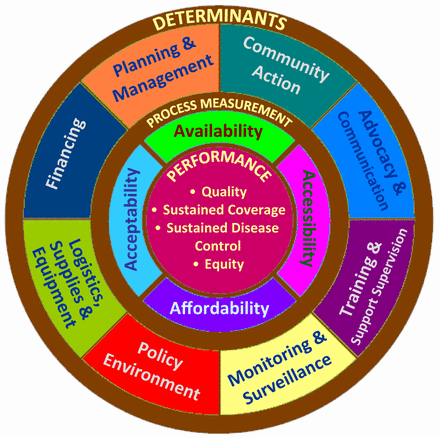
As part of his argument that strengthening RI within the overarching health system must be recognised as a development challenge, Steinglass stresses that retaining the trust of families and communities requires systematic effort to ensure the predictability and quality of services. "Families need information and counseling to become aware of and accept immunization services. Families must know where and when to come for immunization and to bring vaccination cards. They must be treated affably and respectfully by health workers." The figure above (and visible on the third page of the commentary) illustrates Steinglass' systems approach, which includes many components, "all of which dynamically interact to influence the accessibility, availability, acceptability, and affordability of services, with a desired result of continuous coverage, improved service quality, equity, and sustained disease control....Many countries in Africa and Asia do not receive a balanced and multidisciplinary package of technical support from partners across the many interconnected components."
As identified by one of the Decade of Vaccines working groups, co-led by the author, key approaches to strengthen performance of RI systems and monitoring must include:
- Strengthening, at a national level, the structure and processes for developing immunisation policy, strategies, and best practices. "This is essential to promote greater country ownership and commitment to the program and to reduce external dependence."
- Improving systems and tools for generating evidence, monitoring programme performance, and using data for action.
- Training, deploying, supporting, and supervising adequate human resources for programme management and implementation.
- Building, maintaining, and sustaining regular immunisation delivery and supply systems.
- Promoting greater ownership, political commitment, accountability, and self-reliance of immunisation programmes at all levels. "Given the numbers of other important stakeholders, ranging from religious and community leaders to civil society organizations, to parents and caretakers, efforts to stimulate and sustain societal commitment are also needed."
- Broadening the engagement of civil society and communities.
- Achieving sustainable immunisation financing and sound financial management.
Steinglass outlines some promising recent developments among global partners in the RI arena. For example, the United Nations Children's Fund (UNICEF) is advocating in all of its programming to reach underserved populations (e.g., the urban economically poor, remote communities, and marginalised groups) and to address equity gaps to support the goal of universal immunisation coverage. That said, he indicates a need to implement RI more smartly, such as by ensuring that technical partners pay greater attention to operationalising the World Health Organization (WHO)/UNICEF Reaching Every District (RED) approach to reach the underserved. Because RI services can be scheduled, they can be better planned, managed, supervised, monitored, and linked with communities. Steinglass believes that the RED approach is a common-sense package for scheduling RI services, but "in too many countries 'doing RED' has become a meaningless mantra, reduced to a one-off training exercise focusing only on the micro-planning component of the approach."
Next, he reflects on the differences between polio immunisation and RI efforts. "A one-time sprint to the polio eradication finish line differs from the marathon approach required to affordably and sustainably develop and strengthen RI programs....Contrary to the GPEI, the RI program must reach individual children in a timely way with all appropriate age- and dose-specific vaccines through reliable and good-quality services, year after year." Thus, Steinglass feels that the polio eradication message needs to be "better nuanced, without overstating what collateral benefits the polio model and assets contribute to RI strengthening....In the near-term, the immunization community must endeavor to advocate the eradication of polio without overstating its so-called 'legacy' for RI."
In concluding, Steinglass calls for a "balanced way forward", which includes, among other elements, efforts on the part of the immunisation community to assure that essential preventive services such as RI continue to work in the context of health sector reform. One component of this would be creating opportunities for countries, districts, and health facilities to learn from each other and to better identify and accelerate the spread of good practices. "A culture of learning is more likely to emerge when it includes multiple perspectives, diverse disciplines, and broad partnerships, and when staff members have an opportunity to learn from peers working on the same problems."
Global Health: Science and Practice, November 14 2013, vol. 1, no. 3, pp. 295-301. Image credit: Adapted from JSI Research & Training Institute, Inc., ARISE Project. ARISE Landscape Analysis Synopsis: An Initial Investigation of the Drivers of Routine Immunization System Performance in Africa [PDF]. Arlington, VA: JSI Research & Training Institute, Inc. 2011.
- Log in to post comments