










































Improving the Monitoring of Immunization Services in Kyrgyzstan
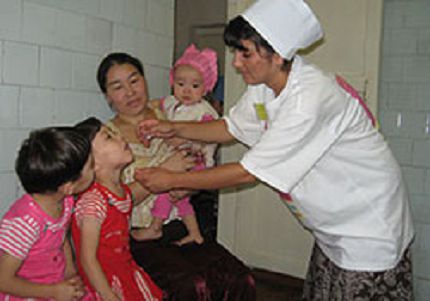
USAID/BASICS Project (Weeks); Ministry of Health, Kyrgyzstan (Svetlana, Valentina); USAID/SEATS Project (Noorgoul)
"The project demonstrated that giving health workers the basic epidemiologic skills to monitor their own work measurably improved the quality of the data, and by acquiring the new skills, the workers developed a sense of pride in their work."
This journal article examines a research initiative designed to improve the national health information system on the part of the government of Kyrgyzstan following the disbanding of the Soviet Union in 1991. As outlined here, to revitalise health services, the Ministry of Health (MOH) first focused on improving their immunisation services, including the immunisation component of the Health Management Information System (HMIS). Secondly, to increase immunisation coverage, the MOH set as a priority the elimination of ascribing false contraindications to immunisation. To address these issues, the United States (US) Agency for International Development (USAID) Resources for Child Health (REACH) and Basic Support for Institutionalizing Child Survival (BASICS) projects provided technical assistance and organised an international seminar.
To accomplish their objectives, the MOH appointed a Working Group to define the problems, revise record-keeping procedures, and develop monitoring tools. This group, representing both national and local levels, was composed of MOH epidemiologists, paediatricians, and a management information specialist. To reduce the burden of excessive record-keeping and reporting requirements, the Working Group identified 4 key indicators for the service delivery level: (i) diphtheria, pertussis (whooping cough), and tetanus (DPT3) immunisation coverage rates for children less than 1 year of age; (ii) contraindication rates for DPT; (iii) usage of DPT vaccine; and (iv) daily refrigerator temperatures. Additional indicators were included at district and provincial levels.
"To introduce these indicators and the practice of monitoring, the Working Group first modified the existing forms and records. They developed worksheets for each level and for each indicator so the medical workers could easily compile data and calculate rates. To apply the indicators througvisual monitoring, the group developed graphs that could easily be constructed by hand. To maintain quality assurance over immunization services, as well as the health information system, analytical supervision checklists were designed for the three supervisory levels: the polyclinic supervising the catchment area health posts, the rayon and the oblast. The checklists not only remind the supervisor about the critical elements of service delivery, but they also remind them to countercheck records with reports to determine the reliability of information. The checklists include columns for aggregating responses to determine scores, thereby allowing for judgement and comparison on performance between facilities and during subsequent visits. The final step before implementing training for the medical workers involved preparing the training manuals for the service delivery and supervisory levels."
Yet, it is noted that the improvements extended beyond systems and forms, emphasising monitoring by the frontline health worker and supervising the quality of health information. "The Kyrgyz followed a genuine 'bottom up' approach, starting with assessment and continuing through training at the base of the health information system, the health post. Their design included easily calculated, graphical indicators. Instead of introducing a new or automated system, they revised existing forms, records, and procedures. They first concentrated on building a reliable foundation; then, in the final phase, they incorporated the national level. The Kyrgyz HMIS Working Group focused their attention on the people collecting the data - the health workers - not only to advance the quality of information but also to encourage timelier detection and reaction to problems."
After a 1-year trial, the MOH implemented the revised HMIS nationally. "Not only did the quality of the information system improve, but the new approach provided visible evidence, from facility to national levels, that the MOH was approaching their objective of reducing contraindication rates for DPT immunizations to 5% or less, and that vaccine wastage could be substantially reduced."
Health Policy and Planning. 2000 Sep;15(3):279-86, sent via email from Mike Favin to The Communication Initiative on February 23 2015. Image credit: World Health Organization (WHO) Regional Office for Europe
- Log in to post comments