










































Five Keys to Safer Food
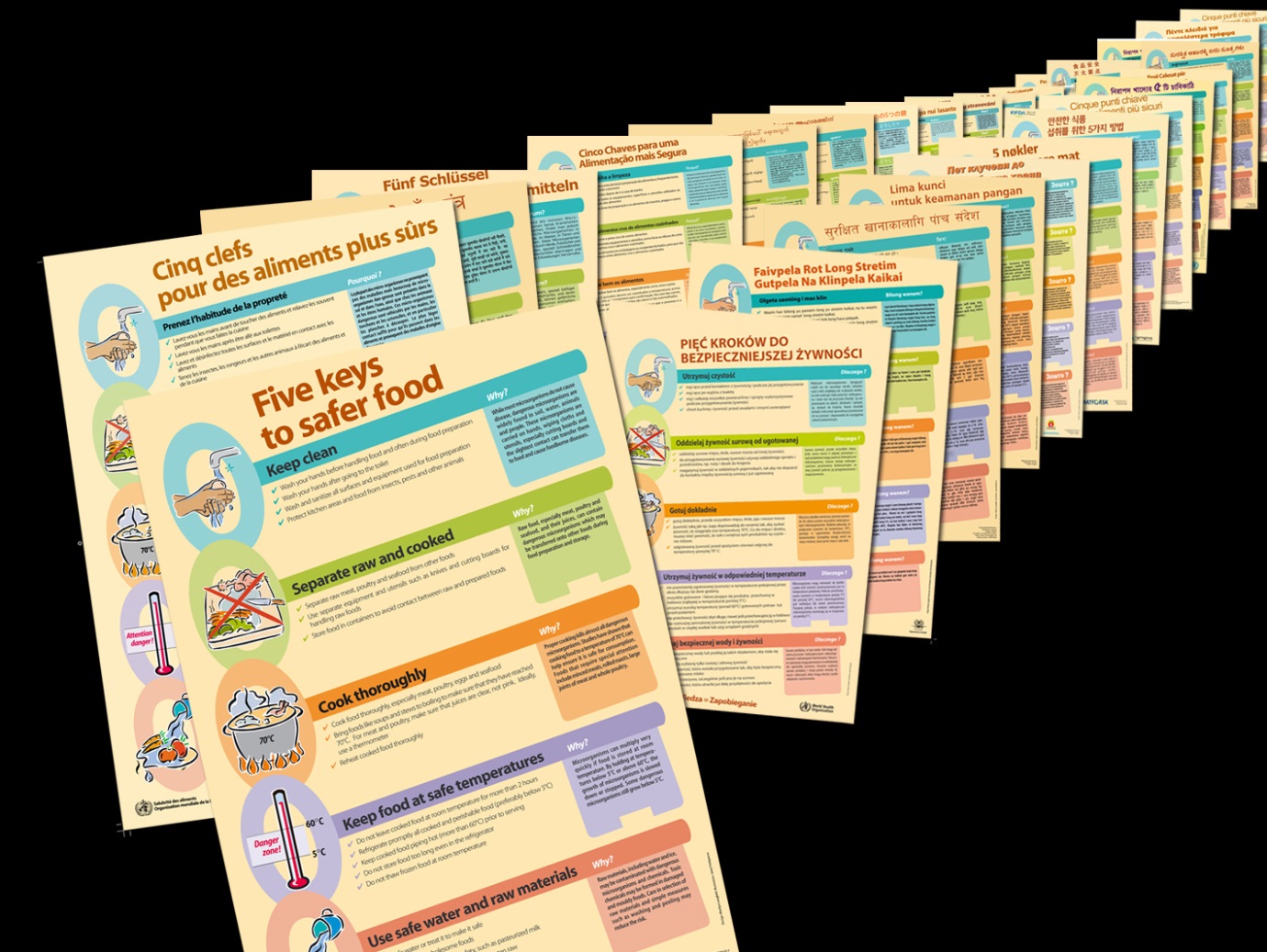
The Five Keys to Safer Food message explains the basic principles that each individual should know all over the world to prevent foodborne diseases: 1. Keep clean, 2. Separate raw and cooked, 3. Cook thoroughly, 4. Keep food at safe temperature, 5. Use safe water and raw materials. The Five Keys to Safer Food message was developed in 2000 by the Department of Food Safety and Zoonoses at the World Health Organization (WHO) to educate all food handlers, including consumers, about safe food handling practices to prevent foodborne diseases.
Every year, 1 in 10 people fall ill from eating contaminated food, and 420,000 die as a result. Children under 5 years of age are at particularly high risk, with some 125,000 young children dying from foodborne diseases every year. There is an evident lack of awareness all over the world that food can make an individual sick if not properly handled, prepared, and stored. As part of its effort to decrease the burden of foodborne diseases and to assist its Member States in implementing food safety educational programmes to prevent foodborne diseases, WHO decided to develop a simple, clear global health message based on sound science and suite of communication materials meant to be easy to adopt and adapt. The purpose is to promote safe food handling behaviours and empower food handlers, including consumers, to prevent foodborne diseases, make safe and informed choices, and have a voice to push for a safer food supply.
Available in several languages, the Five Keys materials include posters and training manuals, as well as an animated video, which "WHO encourages countries to share, post on web sites and translate to maximize its dissemination." To ensure the same understanding in practice along the full chain, WHO has developed additional Five Keys materials directed to rural people who grow fruits, vegetables, and fish for their own use or for sale in local markets. WHO's objective is to reach those who usually do not have access to food safety education despite the important role they play in producing safe food for their community (e.g., rural women).
The Five Keys to Safer Food were used widely to celebrate the World Health Day 2015 dedicated to food safety. The large number of activities undertaken by countries to celebrate the World Health Day, ranging from television spots to cooking demonstrations, demonstrated the impact and usefulness of a simple, global health message that is easy to adopt in and adapt to local settings.
"Working with WHO's network of regional and national offices and partner organizations, the Five Keys messages can be successfully disseminated all over the world. WHO encourages governments, industry and consumer organizations to disseminate this important food hygiene message."
Main manual: Arabic, Chinese, Croatian, English, French, Italian, Japanese, Portuguese, Russian, Spanish, Tajik. Video: Albanian, Arabic, Azerbaijani, Bosnian, Cantonese (subtitled in Chinese), Chinese, English, French, Hebrew, Italian, Polish, Portuguese, Russian, Slovak, Spanish, Turkish, and Vietnamese. Poster: 88 languages.
Emails from Françoise Fontannaz to The Communication Initiative on March 9 2017 and March 14 2017; and Five Keys page on the WHO website, March 9 2017. Image credit: WHO - Photo of fruits and vegetables
- Log in to post comments